




From its proven action to its solid sighting rib and good stock shapes, this well proportioned, pointable 30in 20-bore has little out of place, says Michael Yardley
Caesar Guerini Magnus Deluxe

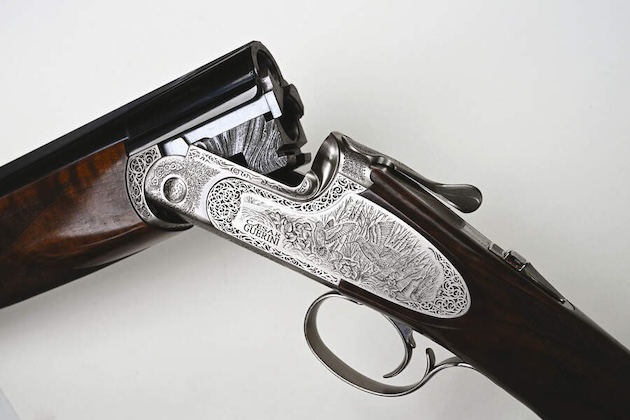
With the game season fully upon us and in a world where so many things, including shooting and new guns, can become prohibitively expensive, I sought out a gun this month that offers good specification and value. A friend had asked my advice on a new pair of driven game guns and we went out with a 30in 20-bore Caesar Guerini Magnus Deluxe to trial as the possible basis for these. The 6lb 11oz Magnus test gun is distinguished by a solid, tapered sighting rib, a classically proportioned pistol-grip stock and game-scene (laser) engraved sideplates. It is fleur de lys steel shot proofed and multichoked (five tubes supplied). A price of £4,500 creates the possibility of a sub-£10,000 pair of guns: not cheap but significantly less than many alternatives and it comes with a 10-year guarantee.
The Magnus is built on a proven triggerplate action. It looks attractive and comes to the shoulder well, as is often the case with 30in 20-bores. All these Guerinis, like similar Rizzinis, seem well proportioned. Both firms have the form and feel of their mid-range 20-bore over-and-unders right. They are my favourites among machinemade guns (although Beretta and Browning will always give anything else a run for its money) but I have to declare bias. I use 30in and 32in Guerini 20-bores for game shooting and clay busting (though for the latter, and real pigeon, I may also revert to my faithful 12-bore Beretta 303 and occasionally a 12-bore 30in Beretta 695 or Webley side-by-side).
I am fond of saying “a 30in 20-bore is always right”, in much the same way as you might say to new stalkers “if in doubt buy a .308” (or .30-06 or .300 Win Mag if your destination is Africa). The advice is based on long experience. In the case of shotguns it seems easier to get a 30in sideplated 20-bore to handle well compared with almost any other type of shotgun. If built around 7lb, as most machine-made guns are now, they rarely disappoint or require much adjustment beyond checking comb height, possibly adding a whisker of cast and testing trigger-pulls. The 30in guns with solid ribs are even better: pointable, steady yet still easy to swing. I like the Guerini and Rizzini guns especially because they are a little deeper in the action. This suits a 20-bore well and allows for an almost perfect grip shape, one that is even in depth with secure anchoring of the rear hand.
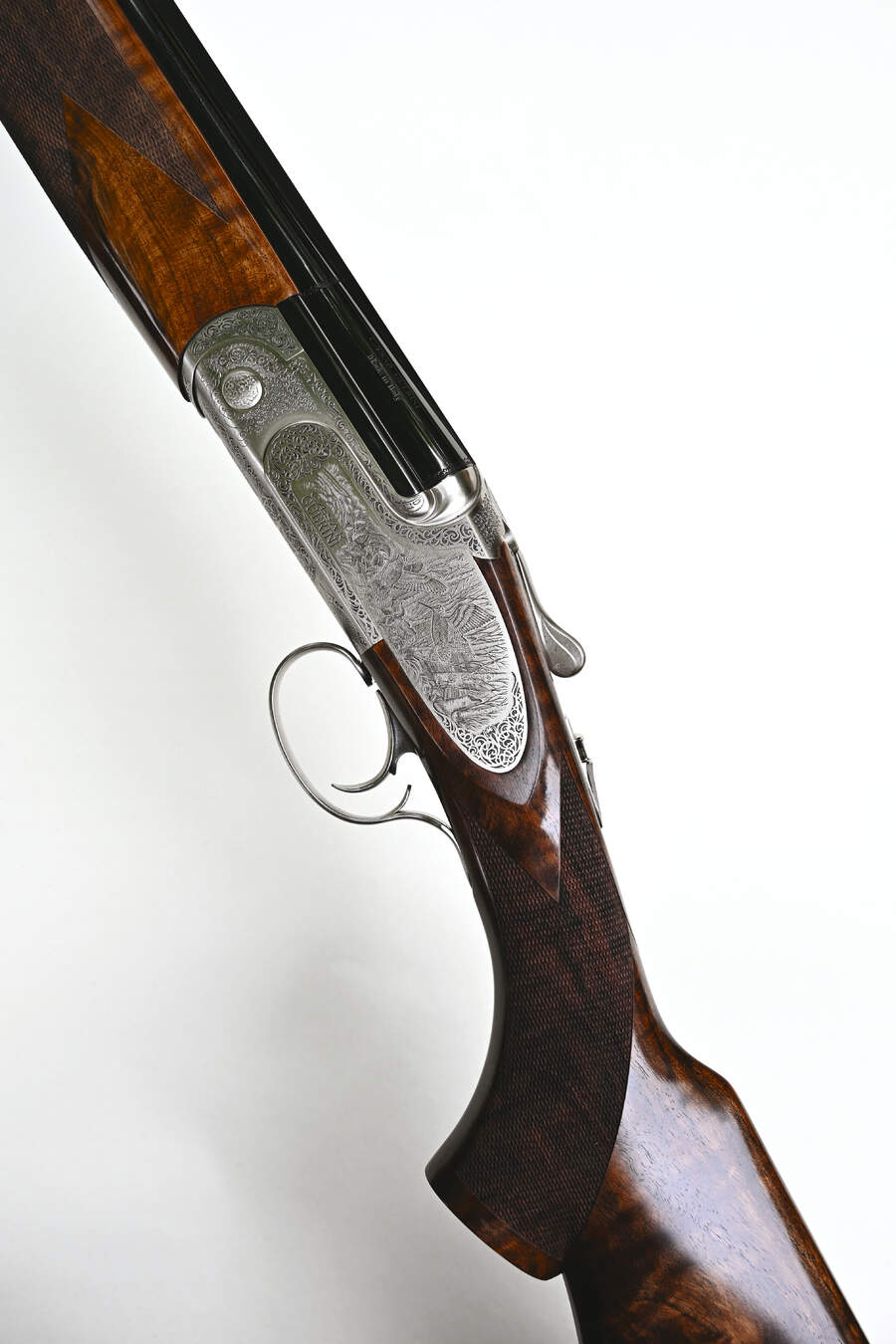
The Caesar Guerini Magnus Deluxe features a pistol-grip stock, a solid rib and game-scene engraving
What of the test gun? It ticks nearly all boxes. It is well finished, balances forward (perhaps a little too far), the wood has good figure and the chequering is in classic panels. I prefer the rounded fore-end to the older fluted style. The engraving looks good but scroll on machine-made guns is more to my taste (as is engine turning or plain polish on the monobloc walls rather than damascus effect as seen here). Deep scroll is still available on the Maxum (and fine scroll on the discontinued Essex model). (Read our review of the Maxum here.)
Is a 20-bore right for you? I rarely feel undergunned with one and tend to use No 5 shot 26g or 28g loads with lead. I have, moreover, found through experiment that an over-and-under around 7lb in 20-bore is the most intuitive, comfortable and natural to use (7½lb for 12-bore stack barrels). Such mid-weight guns control recoil well and encourage fluent, elegant shooting style. The 30in 20-bore is the new 16-bore in many ways: big, heavy 12-bores are far more burdensome in the field and the ammunition is bulkier. This doesn’t make the 30in 20-bore right for everyone but try one and you may be smitten by its charms too.
Technical
This trigger-plate design is similar to several from Val Trompia that have been refined in the era of tight-tolerance CNC. The Magnus has trunnion studs located in bifurcated lumps like a Beretta or Perazzi. It allows for a lower action profile. The locking system here, however, is more Browning-like and involves a wide bolt coming from the bottom of the action face and engaging a slot bite beneath the bottom chamber mouth. This is a well-proven arrangement and used by many other makers. It has more bearing surface than some of its rivals utilising conic bolts and bites. By placing the bolt and bites beneath the bottom chamber mouth the gun is, of necessity, made a little deeper in profile than might otherwise be the case with a split hinge-pin design. It allows for an almost perfectly proportioned grip in a 20-bore, as discussed, but may arguably be a little deeper than ideal in a 12-bore.
Shooting impressions
There is little out of place in the Magnus Deluxe – that applies as much to its shooting qualities as its form and mechanics. It points and controls recoil well and the weight is good. Increased central mass from the sideplates enhances handling, and the aesthetics please. A rugged action is coil-spring driven with a selective inertia-activated single trigger. Trigger-pulls were fine and their function reliable. Ejection was positive. The action is not as shallow as some but better for it in a 20-bore as it allows for a little more grip depth forward and better purchase. Overall, the design is conventional but well executed: no radical innovations (although they are to be found in the Guerini Invictus, which offers ingenious ‘reverse trunnions’ and a replaceable recoil block mid-action). The Magnus offers solid engineering with modern manufacturing precision and laser-enhanced finish. For field or sporting use, it’s hard to beat at the price point. It punches above its weight and will not disgrace in any company.
Caesar Guerini Magnus Deluxe 20-bore
RRP: £4,500