




How did the deceptively simple sport of croquet find, and retain, its niche? Harry Wallop investigates.
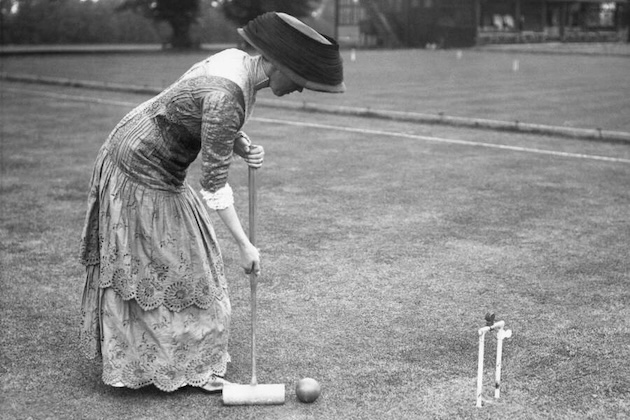
The Great Exhibition of 1851 saw a dazzling variety of inventions shown to the public for the first time, from flushing toilets and waterproof watches to Samuel Colt’s Navy revolver. But one particular brainchild has brought more amusement than most and is still very much part of a British summer: croquet.
Origins of croquet
The exact origins of croquet are a little murky but Jaques of London, ‘Manufacturer of Ivory, Hardwoods, Bone and Tunbridge Ware’, exhibited at the 1851 event and claims this is the first time most people encountered the game. The company produced all sorts of trinkets but was becoming increasingly proficient at making toys.
“There’s no record of croquet before that,” says Joe Jaques, eighth-generation boss of the family-run company. “So, we claim to have been the introducer and the inventor of croquet.” Within 15 years it had become such a craze that it was well enough known for it to appear in Lewis Carroll’s Alice’s Adventures in Wonderland. Readers may have been baffled as to why the Queen of Hearts uses a flamingo instead of a mallet and soldiers for hoops but they did not need to have a mallet and hoop explained. This was a game being played on vast numbers of mid-Victorian lawns.
Summer weekends of fun
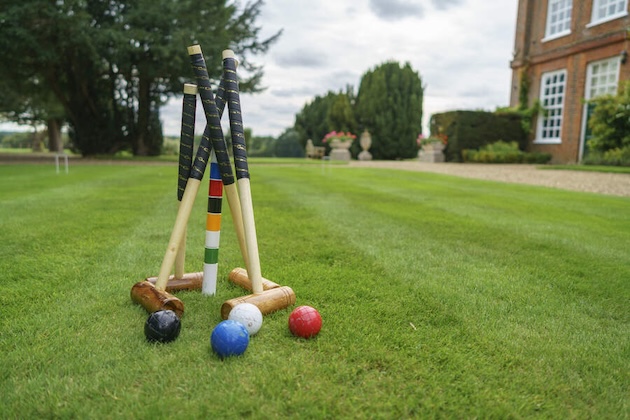
Children and adults in 21st-century Britain are no longer gripped by croquet in the same way that our forebears were. Leisure centres across the country are not tearing up their tennis courts to replace them with croquet lawns – they are building padel courts instead. But for those who play it, croquet is a quintessential part of a perfect summer’s weekend of fun.
“It’s the ideal family game. Men and women can play together, children and their grandparents. For a skilful and competitive game that anyone can have a go at, there can’t be much better,” says Harry Bowcott. He plays croquet at the Hurlingham Club, west London, where it is taken especially seriously. His love for the game is so keen that on moving to a Norman manor house in south Gloucestershire a decade ago he ripped up the front lawn and installed a croquet lawn – after levelling it using a mechanical digger.
“It involved moving a huge amount of earth. And every year, you have to top dress the lawn to take into account the divots, the wear and tear,” he reveals. Serious croquet players are quite obsessive about their lawns. Bowcott has even bought a roller from the local cricket club to ensure the smooth running of his balls.
Prominent players
The fact that anyone of any age can play croquet is part of the appeal. Sir Winston Churchill axed the tennis court at Chartwell, Kent and replaced it with a croquet lawn, and was known to play the game, after the war, with Viscount Montgomery of Alamein when he came to visit. One can’t quite imagine these two great military tacticians sweatily playing tennis.
Despite its reputation as genteel and as British as a plate of cucumber sandwiches, croquet is popular in the US, with celebrities including Madonna, Brad Pitt and George Clooney all having been photographed playing. The current world number one is Robert Fletcher, from Australia. It has also taken off in Egypt, a country that has embraced the game so much that it often tops the international rankings. And though it is frequently thought of as the ultimate toff’s pastime – Sebastian Flyte breaks his foot tripping over a croquet hoop in Brideshead Revisited – famously, the gruff and bluntly spoken John Prescott was snapped playing croquet with his aides when he was meant to be running the country in 2006. He insisted later that “you can still be working class” and play croquet.
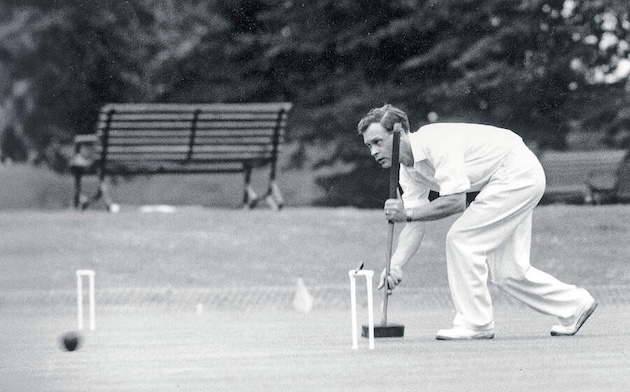
John Solomon in play at the annual Croquet Championships in 1962
Deceptively simple
For those who have never had a go, it looks deceptively simple: you use a big mallet with a long handle to hit the ball through six hoops before eventually hitting the wooden peg in the centre of the lawn. Ideally, you would do this while enjoying a glass of Pimm’s or pint of Kentish ale. But it is a bit more complicated than that. For starters, there are two types of croquet. Golf croquet is a simplified version of the game that many people play at home, school or at a country house hotel. This is when each player gets one ball and one stroke at a time, and tries to get their ball through the hoops before their opponents. The first person to reach a hoop gets that point, and all the players move on to the next hoop. A game can be over in 15 minutes.
Association croquet
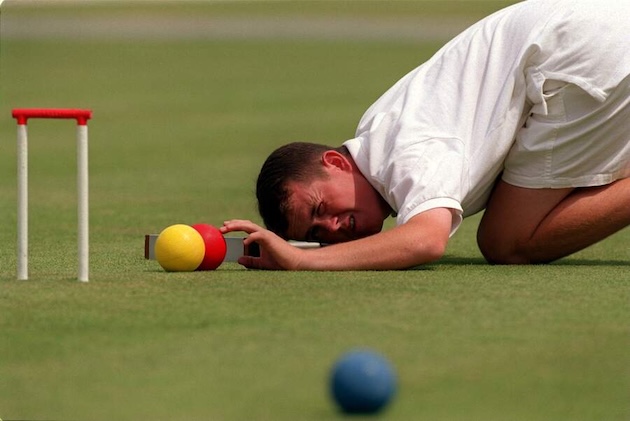
The other version is association croquet: more complex, more strategic, longer. Think of it in cricket terms – association is Test match compared with the flashier 20:20 golf croquet. “I’ve had games that have lasted four hours,” says Chris Williams, a former world top-20 player who has captained Wales. “It’s like playing snooker, where you are trying to build a break.” In association croquet you have two balls each. Black and blue play red and yellow. If you hit your ball through a hoop, you gain another shot; if you hit it against your opponent’s (a ‘roquet’) you can pick your ball up, place it against theirs and thwack the latter in any direction (‘a croquet’), again winning an extra shot.
A skilful player can spend hours gradually working their way through the hoops, racking up points, while their rival is left stranded, watching in despair as their balls are croqueted out of the game. If, like me, you thought croqueting involved putting a foot on your ball before whacking it, so that it remains stationary while your opponent’s goes flying, you are mistaken. “It was part of the game until about 1900,” says Williams, who also acts as Croquet England’s archivist. “It was known as tight croquet.”
Joe Jaques admits that many amateur croquet players enjoy using this outlawed rule. After all, what could be more fun than seeing your rival’s ball fly into the hydrangeas? “I used to fight against it but great games live on because they are owned by the people who play them.” For him, it’s more important that people pick up a mallet and have a go – even if they don’t play by the rules strictly. “What I love the most about croquet is every family seems to play a different version of rules, which have been passed down by the generations.”
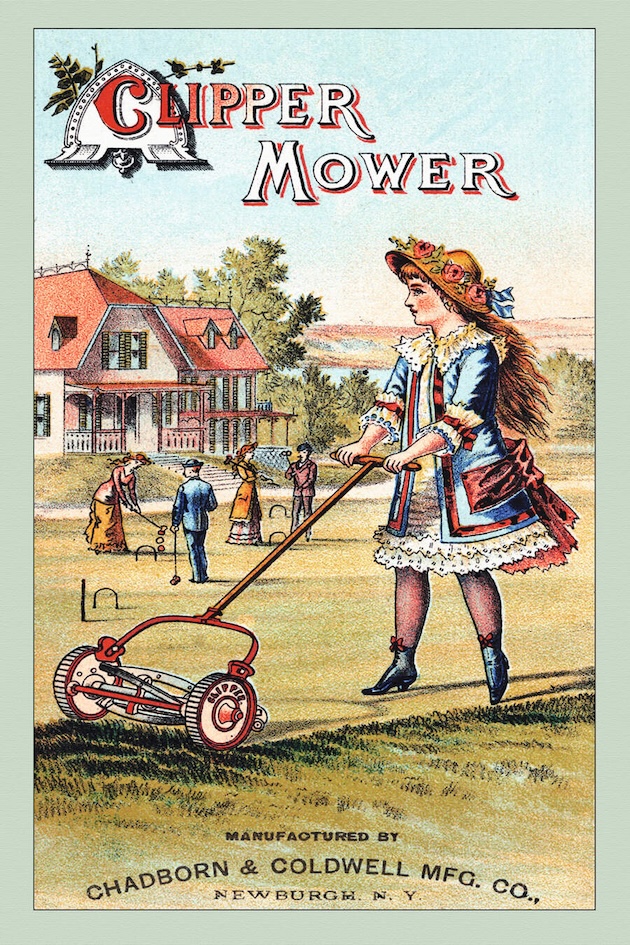
Croquet benefited greatly from the invention of the lawn mower
His story about Jaques being the first manufacturer to popularise croquet is disputed by a few experts. Roger Bray, in the Croquet Gazette, the official newsletter for Croquet England, suggests a rival manufacturer – Isaac Spratt – should take the credit, possibly bringing it over from Ireland or France (hence the Gallic name). What is not in dispute is the sudden popularity of the game in the 1850s. Outdoor games involving balls and mallets had been around for a long time. Samuel Pepys, in his diary, records watching the Duke of York play ‘pelemele’ in St James’s Park in 1661. This game, now usually called pall-mall, from which the London thoroughfare gets its name, involved players using a mallet to strike a ball between two distant arches in as few blows as possible.
“Croquet is thought to take off partly because of the advent of the lawn mower,” says Williams. This ingenious machine was invented in the 1830s. “You need smooth grass surfaces for croquet,” he adds. The other reason is that in Victorian Britain there were precious few occasions when young men and women could gather and flirt together. Even when wearing layers of crinoline, a woman could wield her mallet as an equal with a man. However, it soon became a victim of the Victorian obsession with codifying every game. In 1863 the rules for association football were drawn up; one year later, croquet received the same treatment thanks to Walter Jones Whitmore, a civil servant who was obsessed by the craze.
Rules and regulations
This is where The Field plays a pivotal role because Jones Whitmore wrote a series of articles for the magazine in 1866, describing the game and laying out his rules, which became known as ‘The Field Rules’. He went on to co-found, in 1868, the All England Croquet Club in south-west London. Yes, Wimbledon, the home of lawn tennis, started as a croquet club. This explains why the longest-running, most successful Wimbledon champion is neither Martina Navratilova nor Roger Federer but an engineering professor called Bernard Neal, who won the (croquet) title 38 times between 1963 and 2005.
The club was formed in the offices of The Field, with the editor John Henry Walsh one of the founding members. It was only in 1875, when tennis took off, that the members decided to convert one of their croquet lawns into a couple of tennis courts – which is why a tennis court is about half the size of a proper croquet lawn. To this day, Wimbledon still has three croquet lawns on site but “during the Championships they actually are used as practice courts”, explains Robert McNicol, historian at the All England club.
The fact that the Wimbledon croquet lawns need to be handed over to the likes of Carlos Alcaraz and Iga Świątek to practise their volleys means that croquet jump shots are prohibited in the weeks leading up to the tennis Championships. A jump shot is when you make your ball pass through the hoop by leapfrogging over an opponent’s ball blocking your way. If you are not sufficiently deft, you can take a divot out of the lawn – hence the ban.
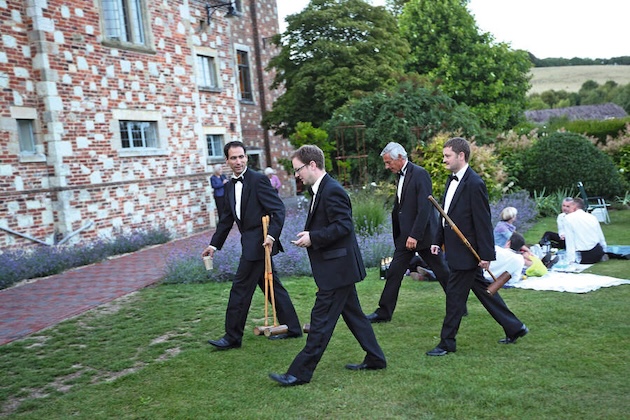
Audience members return a croquet set after playing a game in the grounds of Glyndebourne
The large dimensions of a full-sized croquet lawn – 35 yards by 28 yards – is one of the reasons so few people play proper association croquet in their garden. You need a serious amount of space. There are just 8,000 members at the 200 clubs around the country, according to Croquet England. People who play just for fun will swell those numbers considerably but “there’s no denying it’s a niche sport. It probably always has been, and it probably always will be,” says Jaques, who sells about 1,500 croquet sets a year, though these figures are kept low by the fact that a well-made premium set, costing as much as £1,400, can last for decades.
Croquet, however, has survived 160 years since the rules were written down in the offices of The Field and it is likely to survive at least another 160 years. Not only is there a huge appetite for any activity that takes people away from screens but croquet combines elements of the best board games with a celebration of spending time outside. And on a warm summer’s day, there is absolutely nothing half so much worth doing as simply messing about on a lawn with a mallet and ball.