



Intriguing in origin and imposing in stature, England’s chalk hill figures are a source of endless fascination writes Madeleine Silver
When the late Henry Thynne, 6th Marquess of Bath, was having difficulty conceiving a child with his second wife Virginia in the 1950s, the couple made their way south from their Wiltshire estate at Longleat to the Dorset village of Cerne Abbas. There on the hillside stands the 180-foot chalk carving of the Cerne Abbas Giant: famously well endowed and steeped in folklore that it can cure infertility.
“We were very much in the dark about what he could do,” Lord Bath told a reporter some years later. “I explained the problem and sat on him.” Ten months later a daughter, Silvy Cerne Thynne, arrived. The named godfather listed at the christening? G Cerne. It has not, however, always been treated with such reverence. Growing up at her family home, Minterne House, the daughter of the 11th Lord Digby, Pamela Digby, who later became the US ambassador to France, is said to have shrieked “God, it’s big!” as she jumped the phallus on her pony.
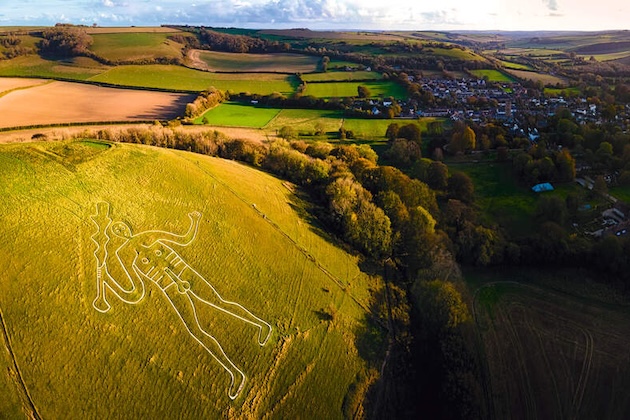
The Cerne Abbas giant in Dorset
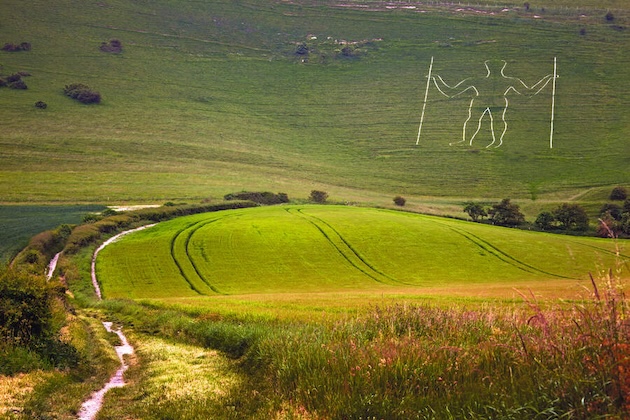
Dorset’s unapologetically explicit landmark is best seen from above but can also be surveyed from a lay-by on the road connecting Sherborne and Dorchester. And as you weave your way through the West Country’s rolling chalk downs, the giant does not stand in splendid isolation: eight visible horses grace Wiltshire’s hillsides alone; there’s the spectacle of military badges between the hilltop town of Shaftesbury and nearby Salisbury; and a solitary kiwi can be spotted at Bulford where Wiltshire makes way for Hampshire. Further afield there’s the Long Man of Wilmington in East Sussex, the Kilburn White Horse in North Yorkshire and the Whipsnade White Lion in Bedfordshire.
“They are easily lost unless they’re regularly kept from growing over, so we don’t know how many there might have been in total,” says archaeologist Martin Papworth, formerly at the National Trust, has several of the carvings in its care. “There are rumours and stories of others but there’s no definitive list and they all range in date, created at different times for different reasons. I suppose anybody with a chalk hillside who wanted to cut the turf and scour the chalk could have done so.”
If each carving is awash with speculation, superstition and intrigue as to their true origin and motive, they’re united in their stop-you-in-your-tracks appeal: mystical creatures that appear on the horizon as you round a bend. “They inspire people’s imagination,” believes Papworth. “People look at them on the hillside and the reason they were carved almost gets forgotten as people make up stories around them. They like the mystery.”
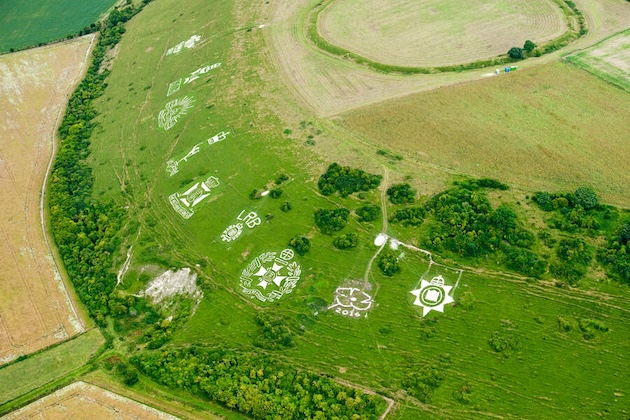
Regimental badges carved into a chalk hill, Fovant Down, in Wiltshire
Surprising results
A week before lockdown in the spring of 2020, Papworth led a team undertaking an excavation of the Cerne Giant’s feet and elbows that would debunk the assumptions surrounding the carving’s long-debated origins. “The results were a great surprise,” admits Papworth, who had thought a 17th-century genesis was most likely, with the 1694 churchwarden’s account of repairs the earliest known record and suggestions that it could have been an unflattering portrayal of Oliver Cromwell. Others had thought he was prehistoric. What they hadn’t expected was that the results of the hi-tech, optically stimulated luminescence testing (which dates sediment based on when it was last exposed to sunlight) would give the clubwielding giant late-Saxon origins.
The revelation has given a new view to its purpose, says Papworth, linking it to the nearby Cerne Abbey as a potential signpost for pilgrims. Founded in 987AD, the Abbey was in the 18th century believed to have been set up to convert locals from worshipping an early Anglo-Saxon god known as ‘Heil’, with the giant a possible depiction of him, though Dorset was largely Christian by then. And as for the phallic addition, Papworth points to a faint line joining the giant’s belt up, which would suggest it was which added as late as the 17th century by a daring landlord – perhaps the flamboyant Lord Holles, who owned the land in the mid-17th century, or the Dorset politician Thomas Freke, who might have been a likely culprit to have “doctored him”, says Papworth.
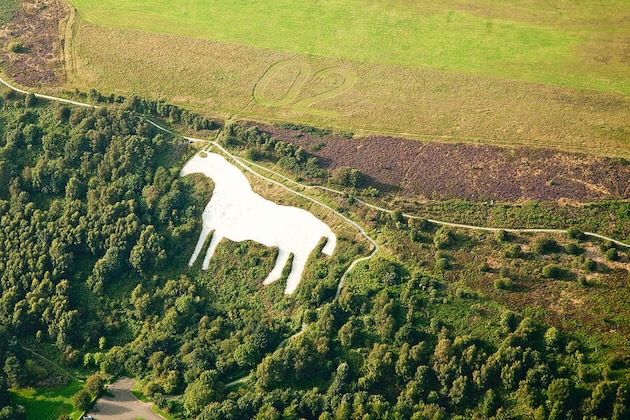
The Kilburn White Horse
in North Yorkshire
Myths and legend
The dating work on the Cerne Giant came about because of the successful use of the same technique on the Uffington White Horse in Oxfordshire in the 1990s, which gave it Bronze Age origins. Longer than a football pitch, it’s the oldest of all the white horses with its striking stylised design (akin to a Matisse masterpiece) and though its ancient roots are more certain now, its purpose is still open for discussion. Positioned on the Ridgeway, which connects notable Bronze Age hill forts and burial mounds, the site has been viewed by archaeologists as a prehistoric tribe’s effort to stake their land rights but this hasn’t muted the storybookworthy legends that abound.
There’s the horse goddess Rhiannon mooted to have inspired it; or perhaps Belinos, the sun god sometimes depicted on horseback. Then there’s the local myth that it gallops across the sky to see a farrier every 100 years or the discourse that it’s not a horse at all but the dragon killed by St George on Dragon Hill across from it. Its prominent position, which the surrounding Vale of the White Horse (and subsequently the VWH Hunt) is named after, means it’s a tempting target for stunts. Before the Cheltenham Festival in 2012, using night-vision goggles, a bookmaker added a giant jockey to the ancient hill carving.
Some 150 miles east on the steep slopes of Windover Hill in East Sussex, the Long Man of Wilmington is a popular pagan site of worship. He has been subject to a fair share of eyebrow-raising additions as well: there’ve been pigtails, hips and breasts in an apparent sex change in 2007; a phallus to rival the Cerne Giant’s in 2010; and most recently a COVID-19 mask. This is another site to have undergone optically stimulated luminescence testing, which in 2003 dated it to the early modern period (the 16th or 17th century) rather than the Romano-British figure or Anglo-Saxon warrior that had been assumed. Its role still baffles archaeologists but it continues to be seen as a symbol of fertility today, with druids and wiccans coming to worship and Morris dancers congregating below its feet at dawn on May Day.
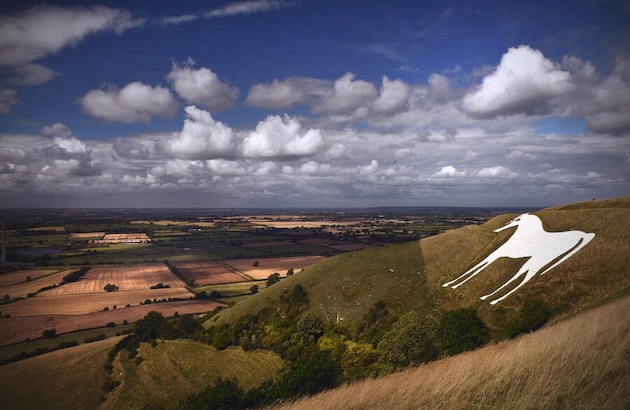
Other chalk carvings are unexpectedly recent additions to our landscape, with the work of George Stubbs said to have inspired the increasingly realistic depictions of horses by the mid-18th century. Three miles to the south-west of the Long Man of Wilmington is the Litlington White Horse. This was cut in the 1830s (possibly to celebrate Queen Victoria’s impending coronation or simply to amuse locals) and carved again in 1924, after it had succumbed to weeds, during the course of one night under moonlight by a group of friends – including the son of one of the original creators.
Lying just below an Iron Age hill fort, the oldest of Wiltshire’s white horses is the 180-foot-tall horse at Westbury. This was first created in the late 17th century, most probably to commemorate King Alfred’s victory in the Battle of Edington, which was meant to have happened at Bratton Camp in 878AD. It was last scoured in 1853, and is now concreted over and painted white. The Osmington White Horse was cut at the beginning of the 19th century in the hills above Weymouth and depicted George III, who regularly visited the town, astride his charger Adonis. But legend says that its direction of travel (leaving Weymouth) offended the King, who never returned. Less shrouded in mystery, but even more recent, are the Fovant Badges dotted along the chalk hillside in south-west Wiltshire, each depicting regimental cap badges. At the outbreak of World War One, the village of Fovant became a training and transit camp for tens of thousands of troops preparing to leave for, and returning from, the battlefields of northern France. And in memory of their fellow soldiers who didn’t return from the Western Front, their regimental badges were proudly carved into the hillside. The first of which was that of the London Rifle Brigade, followed by others from British and Commonwealth units who passed through the camp.
Over the course of the 1920s the badges became overgrown, and during World War Two they were covered up entirely so they couldn’t be used as landmarks by enemy aircraft (other chalk carvings were deliberately painted green during the war to camouflage them), and it was only after the war that the task of restoration began. In 1950-51 the Royal Wiltshire Yeomanry and the Wiltshire Regiment had their badges built by the former Fovant Home Guard troop, and the Royal Signals badge was added in 1970.
On the centenary of the first badge being carved in 1916, an 80-foot poppy was added by volunteers to the eight remaining badges, painstakingly removing the turf and top-soil and filling it with chalk. As Richard Bullard from the Fovant Badges Society said, catching a glimpse of the badges makes you think of the young men going to France wanting to make their mark: “a message to the future from the past”.
Battling animal grazing, creeping overgrowth and subsidence to keep our chalk carvings alive has always relied on willing volunteers. Scouts can be seen abseiling down the Cherhill White Horse outside Calne, weeding as they go; students at Marlborough College have been roped in to clean their local white horse; while ahead of the London Olympics residents in the village of Osmington set about a two-year restoration project to smarten up their bedraggled horse before it was in the spotlight for the Olympic sailing at Weymouth. On ‘chalking day’ at the Uffington White Horse, knee pads, buckets of chalk and hammers are dispensed for the annual cleaning ritual – with those allocated the eye taking the opportunity to make a wish on it.
Yearning for mystery
This primal quest to make our mark in the land that began at least 3,000 years ago shows no signs of abating: in January 1969 residents in Laverstock near Salisbury woke to find the 55-foot face of a panda carved in the chalk hillside staring back at them (a prank devised in a student union bar); in 1999 the most recent of the Wiltshire white horses was carved near Devizes to celebrate the millennium; and in 2003 a carving of a horse designed by artist Charlie Newington and inspired by the Uffington White Horse was finished outside Folkestone on the Kent Downs. And as archaeologists and historians strive to unearth each of their true origins and purpose – whether they were statements of political and religious protest, commemorations or just attentiongrabbing follies – they come up against a resounding yearning for these hillside creatures to retain some of their secrets: an enchanting air of mystery in a modern world of predictability.