




From undertaking humanitarian missions to hosting Royal honeymoons, the revered Britannia has a history that continues to captivate millions writes Daniel Pembrey
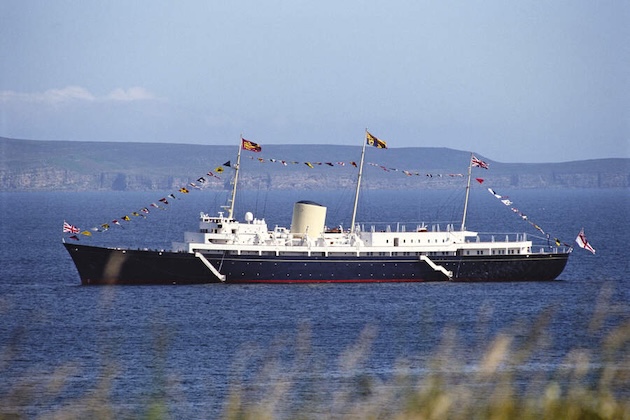
“I am sure that all of you who are present here realise how much the building of this ship meant to the late King, my father,” spoke the late Queen on a gusty River Clyde in Glasgow, launching HMY Britannia in 1953. “He felt most strongly, as I do, that a yacht was a necessity and not a luxury for the head of our great British Commonwealth, between whose countries the sea is no barrier but the natural and indestructible highway.” Due to post-war austerity, the bottle smashed against her hull was Empire wine, not champagne. Still, Britannia made fitting use of that natural and indestructible highway, providing vivid formative experiences for His Majesty the current King, his younger siblings and so many others who boarded or merely beheld her, sometimes floodlit at night, sometimes gleaming by daylight, invariably in dramatic settings. The effect can still be felt today at a newly expanded visitor centre in Edinburgh’s Port of Leith.
Britannia’s shiny, blue surfaces drew inspiration from the late Duke of Edinburgh’s 29-foot sailing yacht, Bluebottle. As the late Duke explained: ‘She was painted dark blue with a red boot topping which I thought looked rather smart, so I suggested that Britannia should be painted in the same colour scheme.’ It proved a challenge to keep this eye-catching finish in tip-top condition. However, her commander at that time, Rear Admiral JH Adams, revealed one strategy was ‘to sail towards a rainstorm if we saw one and sit under it, turning first one side and then the other to the rain. Thus the whole of the yacht’s side was given a quick rinse.’ If only every cloud left such a silvery shining.
She was a one-off opportunity for a young couple to shape a palace in their image. The resulting Royal Apartments, designed by Sir Hugh Casson to be a country house at sea, would impress visitors for the next 44 years (and beyond) with their balance of grandeur and understatement. Rarely would an invitation to dine or visit be declined, up to the level of US presidents. “I know I promised Nancy everything in the world when I married her, but how can I ever top this?” marvelled Ronald Reagan on board.
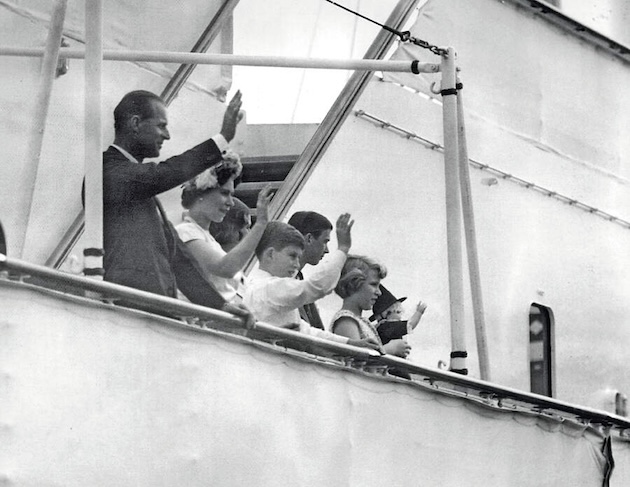
Prince Philip, the late Queen, the then Prince of Wales and Princess Anne wave to the crowds as they sail from Cardiff
For her maiden global circumnavigation between 1956 and 1957 Britannia made it as far south as the Antarctic Circle, clocking up 39,549 miles in 110 days, visiting the most remote communities in the southern hemisphere, several only accessible by sea. On entering the Roaring Forties (named after latitude), the men aboard grew beards, Prince Philip included. The sense of privacy and affinity with the yacht’s special environment led the Royal Family to feel uniquely at home and at ease. The tradition of Britannia hosting Royal honeymoons began with Princess Margaret’s in 1960. Lady Glenconner, who later became Princess Margaret’s lady-inwaiting, was living on the more primitive Mustique at the time when one of Britannia’s tenders approached shore. “A man in white naval uniform appeared with an invitation to dine with them on the yacht,” recounts Lady Glenconner. “I wrote back: ‘Ma’am, it is very kind but we haven’t had a bath for about two months.’ A reply came saying they understood but wished for our company anyway, and would have a cabin put at our disposal. I soaked in that bath for quite some time. Bliss.” (Read our interview with Lady Glenconner here.)
Seventeen years later, during her Silver Jubilee, the Queen returned to Mustique on Britannia to visit Princess Margaret, by now living there. “She had a picnic with the Queen, who took to the water afterwards,” recalls Lady Glenconner. “This was extraordinary. She rarely swam anywhere, presumably for fear of being photographed.” Britannia also permitted the Royal Family to recuperate between official engagements ashore or functions aboard. Sailing at night, she allowed for visits to different islands on consecutive days during Caribbean tours. For all the later talk of costs and budgets, the yacht proved a remarkably efficient way of moving between countries. Over her lifetime, she would support 696 Royal overseas visits and a further 272 in home waters.
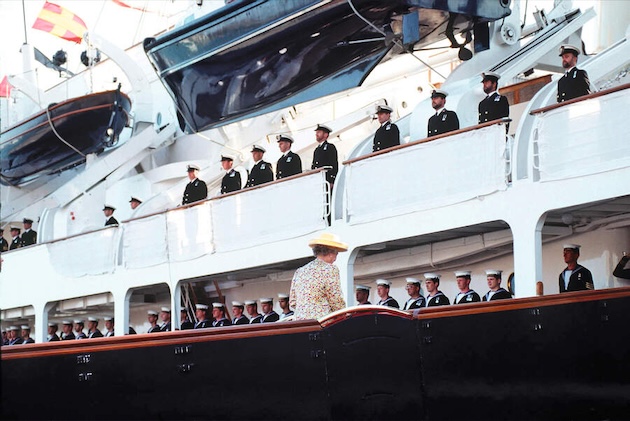
The late Queen boards Britannia for a cruise round the Outer Hebrides in 1995
A place of wonder
For the Royal children, she was a place of wonder. HRH The Princess Royal recalled the yachtsmen constructing a model of Britannia that she could actually drive or pedal around the deck (‘an astonishing piece of kit’, she remembered) and a water slide they rigged up that ‘came down the steps beside the Verandah Deck’, she said. ‘The fire hose was turned on at the top of the slide. Because the slide had a kink at the bottom, we would come down much faster with the water on, hit this puddle and go straight on across the deck pretty well towards the end.’ Recollections of the then Prince Charles prove yet more evocative. ‘I went down to watch the rum being rationed,’ he later confessed. ‘I have always had a thing about rum ever since because it smelt so delicious.’ Admiral Adams recalled him on deck playing with a football, which he kicked over the side: ‘The yachtsman assigned to keep an eye on Prince Charles said “Shall we go back for it?” The Prince replied “Yes please.” So I ran up to the bridge and asked if we could turn round and launch the boat to get the ball. Prince Charles thought this was enormous fun, so as we got under way again the Prince kicked it over the side again. I said “Sorry, we’re not going back a second time.”’
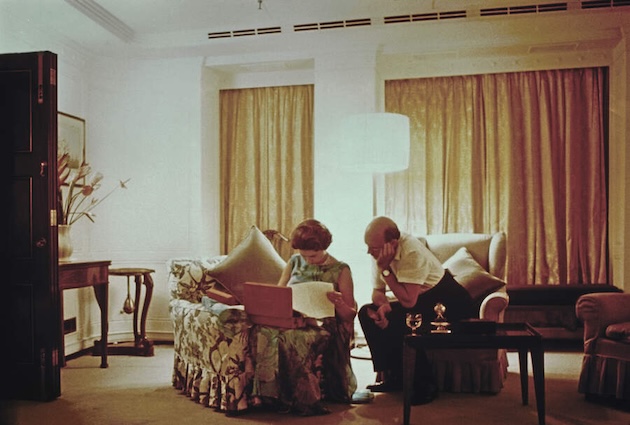
A country house at sea: the late Queen and her private secretary Sir
Martin Charteri reviewing papers in 1972
Having more than 240 yachtsmen and officers allowed for unique kinds of specialisation. The shipwrights, who could seemingly make or fix anything, rightfully received much attention. Yet the yacht’s first commanding officer, Captain JS Dalglish, revealed a wider versatility while discussing recruitment: ‘We had plenty of choice and found ourselves looking for people with unusual interests such as football referees, concert party experts, those who liked sailing or who had distinguished themselves in some way.’
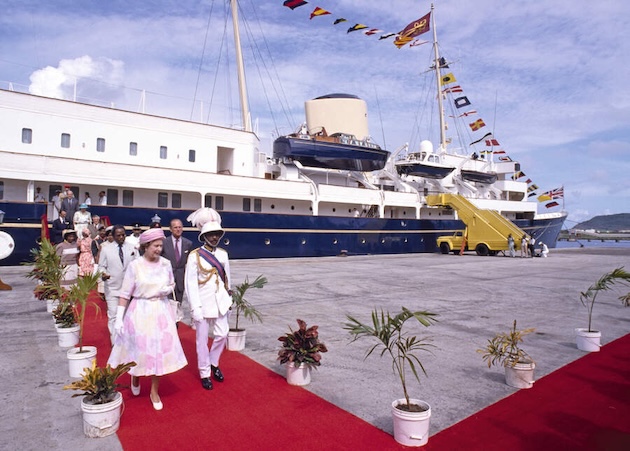
The late Queen and Prince Philip disembark the yacht at St Kitts in 1985
One way they collectively distinguished themselves was by their silence, receiving orders using hand signals and noticeboards placed around the ship, and wearing plimsolls to further reduce noise. There was no loud tannoy or broadcast system. It created an atmosphere of effortless serenity. Aides to US President Ford were fascinated by how yachtsmen with them, outside the dining room in which their charge was ensconced, knew when he was within five minutes of leaving when they did not. Visitors were also astonished by how spotless the ship was, down to her laundry room, where temperatures could skyrocket in the Tropics, or the engine room; the mat before the entrance was intended for those entering, not leaving. ‘For me, it always seemed to be another home, like Balmoral or Sandringham,’ summed up the (now) King when describing annual summer sailings in Scotland’s Western Isles. ‘These people were always so loyal and had such high standards down to every last detail. They could turn their hand to almost anything, and do it properly – it was incredible. I was lucky enough to be transported in this living, working, sailing demonstration of the best of Britain.’
Britannia also served as a casualty evacuation ship, memorably in January 1986 off the coast of Aden. “One night, at 11pm, a Daily Order appeared on the noticeboard saying there’d been a military coup and Britannia was needed for a rescue operation,” reports William French, then a Royal steward. “Word soon returns that we have to bribe the rebels with provisions for them to hold off from firing. I pulled together half-a-tender-boat’s worth of chocolate and cigarettes.”
French goes on: “We had to strip the Royal Apartments, putting down tarps; getting medical facilities ready. We brought on 480 evacuees. The fear and gratitude in their eyes was unforgettable, so, too, the accumulating stench in those apartments.” The yacht ferried them across the Gulf of Aden, to Djibouti, returning to pick up more. “We went on this way for six days, rescuing 1,082 souls of 32 nationalities, till we came under direct fire ourselves, the shells screaming and thudding and landing within 20 yards of the hull. By the end, we could see the tanks massing on the beach. Only then did we leave.”
It took two weeks to clean and disinfect the ship and return the apartments to regal condition. The Queen was steadfastly supportive of the operation, and effusive with pride and appreciation. In 2023 one of the evacuees caught up with French at Britannia’s visitor centre in Leith. “He’d woken up one morning in Aden to the noise of a mortar shell flying through his hotel room window and smacking into the wall behind his bed,” says French. “He was sure he’d die out there, and described the appearance of Britannia on the horizon as being ‘like a dream’.”
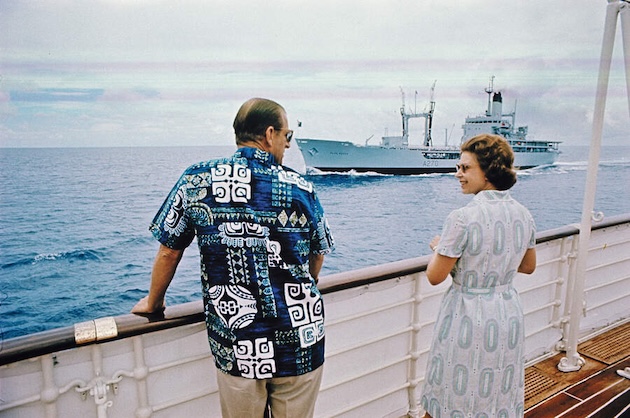
The Royal Family felt uniquely at home and at ease on their ‘floating palace’
Her final engagement
Other memorable juxtapositions followed, notably Britannia ceremonially floodlit for the handover of Hong Kong in 1997. Former defence secretary Sir Malcolm Rifkind had already concluded that Britannia could not be refitted: in order to meet legally required health-and-safety standards, the degree of repair and modernisation needed would have been ruinously expensive. Now came the announcement, under a new Labour government, that there would be no replacement. “I always hoped for a successor yacht,” says Sir Malcolm, who, as Secretary of State for Scotland, had stayed on Britannia during her 1986 Western Isles cruise, sharing a picnic with the Queen on Oronsay in the Inner Hebrides – “most informal”, he recalls.
Fully 7.5 million people have visited Britannia in Leith: more than the populations of Scotland, Denmark or Norway. The visitor centre, which reopened in May, is larger; its shop some 70% so. While a little of the majesty and mystique may have departed, our understanding of Britannia’s value has only grown, giving us a chance to take stock of why she’s so revered.
Britannia’s place in Britons’ hearts wells from her unique blend of roles: theatre for State occasions and projection of ‘soft power’; unusually well-adapted floating Royal residence; intrepid explorer yacht (with more than a million miles sailed); aquatic playground for younger Royals; valiant hospital ship; unrivalled venue for the promotion of British trade; plus, an academy for the perfection of seamanship, the like of which hasn’t been seen since. While she reflects a system of rule belonging to the last century, her precepts of excellence will remain forever relevant.
The writer is especially grateful to Richard Johnstone-Bryden for his official history of the Royal Yacht Britannia. To find out more, visit Royal Yacht Britannia.
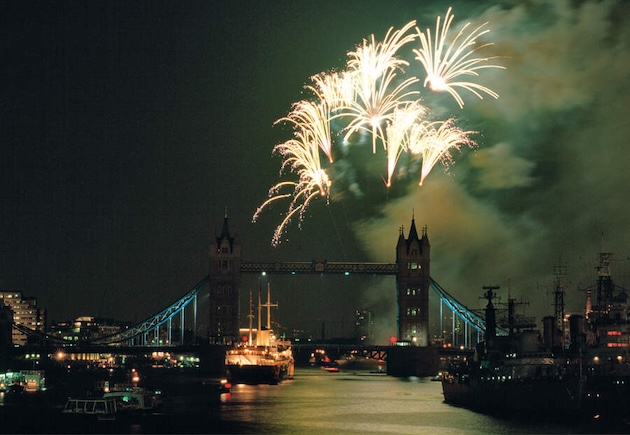
Britannia on the Thames during the 50th anniversary celebrations of Victory over Japan Day in August 1995
Britannia’s spiritual successor
With a brick inglenook-style fireplace in her Tiree Lounge, individually designed cabins (named after Scottish landmarks) and overall countryhouse- at-sea feel, the Hebridean Princess may be the spiritual successor to Britannia. Certainly the late Queen chartered her twice, for her 80th birthday in 2006 and again in 2010, recreating Britannia’s Western Isles cruises. Indeed, owner Hebridean Island Cruises is the only cruise company to receive a Royal Warrant from the late Queen. The sailing season is April to October and a seven-day cruise from Oban starts at £3,450 per person, all-inclusive. For more information visit Hebridean Island Cruises.