



The timeless setting steals the show during a singular day on an estate steeped in game shooting history, writes Adrian Dangar
Hunting has the famous coverts of Cream Gorse, John Ball and Ranksborough Gorse to name but a few of many historic landmarks whose name quickens the pulse of thrusters throughout the land. Fishing has the hallowed Junction pool on Tweed or any number of celebrated Spey beats stretching upstream from Spey Bay such as Orton, Arndilly, Knockando and Castle Grant. But when it comes to driven game shooting there is one name that trumps all others for historical significance – the 2nd Marquess of Ripon’s mythical playground at Studley Royal, which at its zenith enjoyed greater fame than Castle Hill, Garrowby and Helmsley combined.
By the time Earl de Grey became the 2nd Marquess of Ripon in 1909 he had long been acknowledged as the best game shot in England, admired by fellow Edwardians for shooting 28 pheasants in a minute at Sandringham, and so quick that he once had seven birds dead in the air. In 1885 he married professional beauty Gladys Lonsdale, whose effervescence and sense of fun were said to be the perfect foil to her husband’s single-minded obsession, which extended to practising with loaders in his drawing room. By the time he collapsed and died on Dallowgill Moor in 1923, having already shot 52 grouse, the Marquess had amassed a grand total of 556,813 head of game to his own gun, including nine tigers, 10 rhino and 241,224 pheasants.
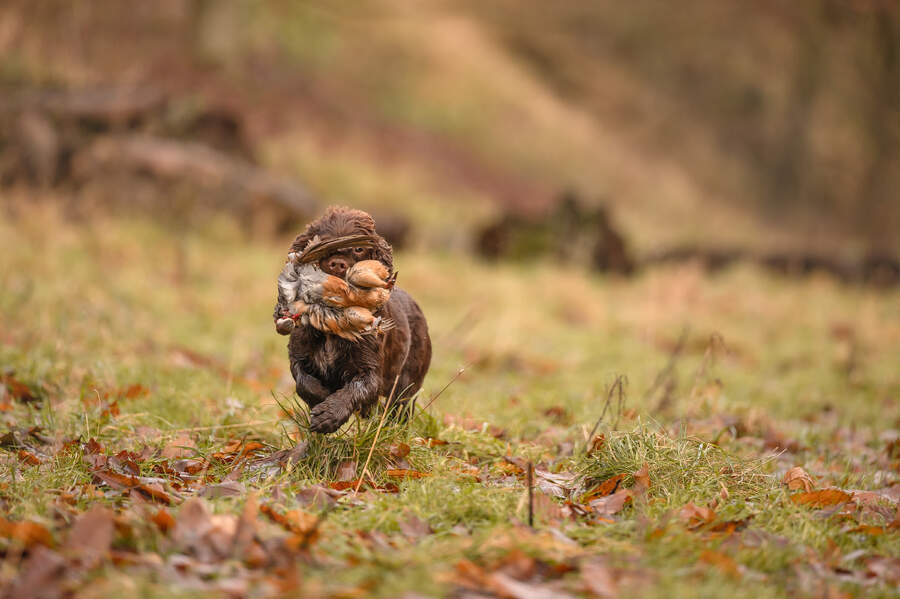
Annalisa Fenton’s energetic spaniel Woody retrieves a hen pheasant
Things have changed a little since then. The shoot at Studley is now owned by Julian Fenton, whose father acquired the sporting rights in perpetuity in the 1970s. Although the shoot extends to Spa Gill and outlying woodlands, today will be spent at its beating heart in the magnificent surroundings of North Yorkshire’s only Unesco World Heritage site. The stunning landscape incorporates the deer park, water gardens and Fountains Abbey, which was founded in 1132 and endures as one of the largest and best preserved Cistercian monasteries in England. These 800-odd acres, comprising roughly a quarter of Fenton’s shoot, were purchased by the National Trust in 1983; however, the Abbey and water gardens are closed to the public every Friday between November and January to accommodate shooting interests. For Fenton, whose ambition is to “produce challenging birds that are killable with a standard cartridge load” on around 20 syndicate and 20 let days a season, it’s a win-win situation. “I can enjoy the sport and surroundings without having to worry about the maintenance,” he explains.
On arrival at the Pheasantry rendezvous on a still December morning that is neither bright nor dull (Fenton had been hoping for a windy day but that was not to be) The Field team are greeted warmly by syndicate members and Annalisa Fenton, dispensing coffee to all comers. The headkeeper is proud Welshman Andrew Richards, who has been a keeper all his life and in charge at Studley Royal for 23 seasons. “It’s been a privilege to live and work here,” he says. “Julian has taken the shoot forward to another level since his father’s day – and young blood has come in too, which is good for all of us.” Richards and beatkeepers Henry Swaine and William Thomas catch-up birds during the season to produce home-bred poults for release in summer. “That way we’re in control of our own destiny,” explains Fenton.
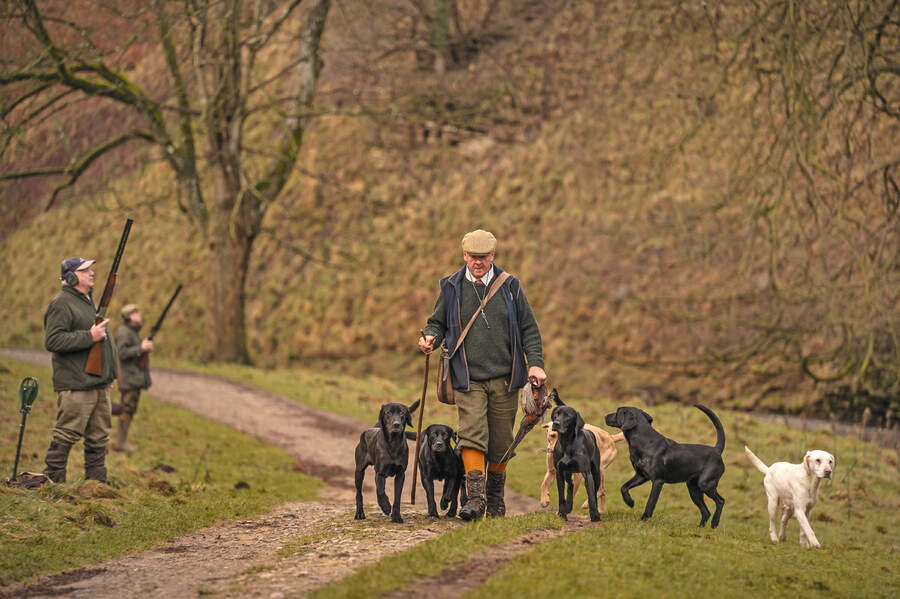
Paul Stogden with his team of talented labradors
With introductions and briefing out of the way, shoot vehicles set off through a park dotted with ancient oak and lime trees beneath the watchful gaze of red, fallow and sika deer. We are en route to Seven Bridges for the first two drives, where the River Skell flows through a steep, grassy gorge beneath a series of hump-backed stone bridges a few miles downstream from her source on Dallowgill Moor. Birds on the opening drive fly straight and true from a cover crop beyond the horizon, just like pheasants ought to, along with redlegs that hurtle over the deep valley. Ed Robinson, who is the guest of an absent syndicate member and organises simulated game shooting on the family farm at Yearsley, stops one of the best to the delight of his father and loader. Peter Bradley, a smartly turned-out jeweller from Harrogate, is also on form here.
By the time the whistle is blown everyone can claim some good birds, although no one has quite matched the Marquess of Ripon and Lord Walsingham’s alleged feat of killing eight Studley Royal partridges from a single covey – it was said that the two best shots in England knew instinctively which four birds were their own. Their Lordships probably didn’t have to contend with a footpath running through the middle of a drive as it does here; guests had been asked to break their guns and stop shooting if necessary but the walkers we met were friendly and accommodating.
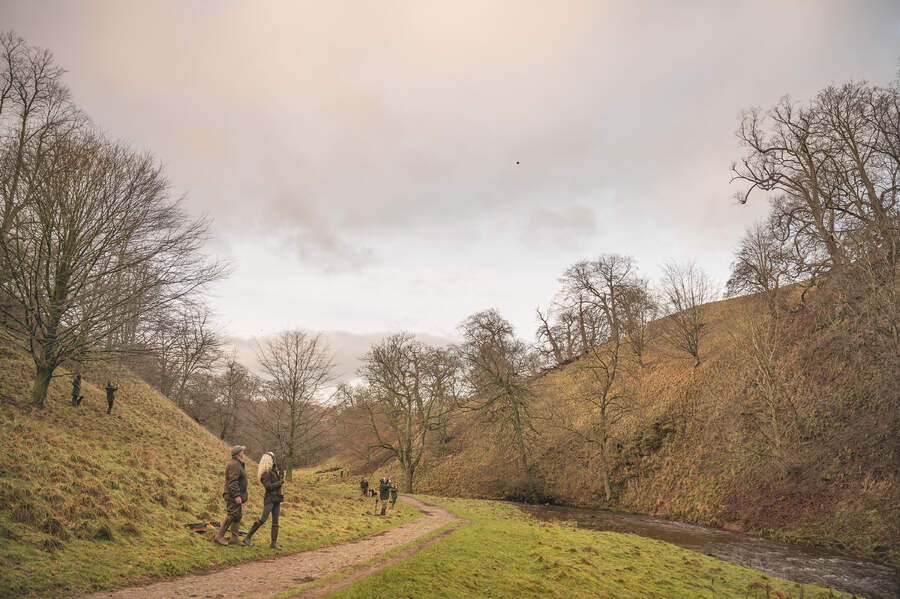
Katy Van Pagh with her loader Ian Ainsley at Seven Bridges
After the second return drive Katy Van Pagh is congratulated for shooting the best bird of the morning thus far, a high crosser that splashed into the River Skell rushing downstream to her junction with the Ure. Van Pagh, who is assisted by loader Ian Ainsley, shoots with a pair of 20-bore Brownings and took up the sport after her fiancé bought her a gun. She was thrown in at the deep end when joining a shoot after just one lesson but took to it like a duck to water. “I’ve not looked back since,” she smiles. “As a teenager I loved beating on the moors for Julian’s father – it was something we all did to earn a bit of pocket money and get some exercise. You only ever saw men shooting back then but now it’s fantastic to see so many ladies out in the field.”
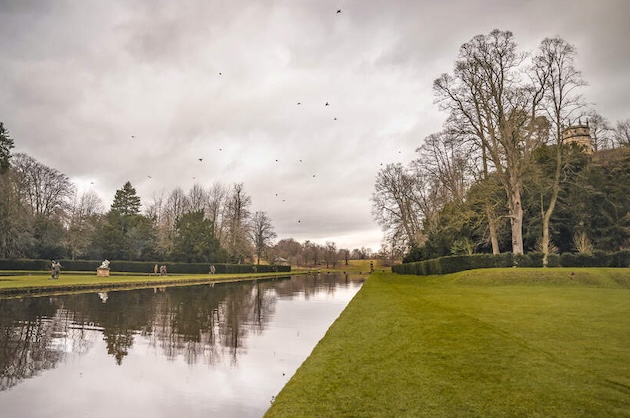
Arriving at the Half Moon Pond for Elevenses feels like entering Eden, for this manicured sweep of the Skell marks the start of one of the most spectacular water gardens in England, where the river has been integrated into the surrounding landscape to create a series of canals, lakes and cascades that flow through pristine lawns overlooked by temples, statues and high banks of towering timber. These sublime Georgian gardens were created around the ruins of Fountains Abbey in the 18th century and are the perfect setting for a glass of cold, crisp champagne served from a table bedecked with the Union flag.
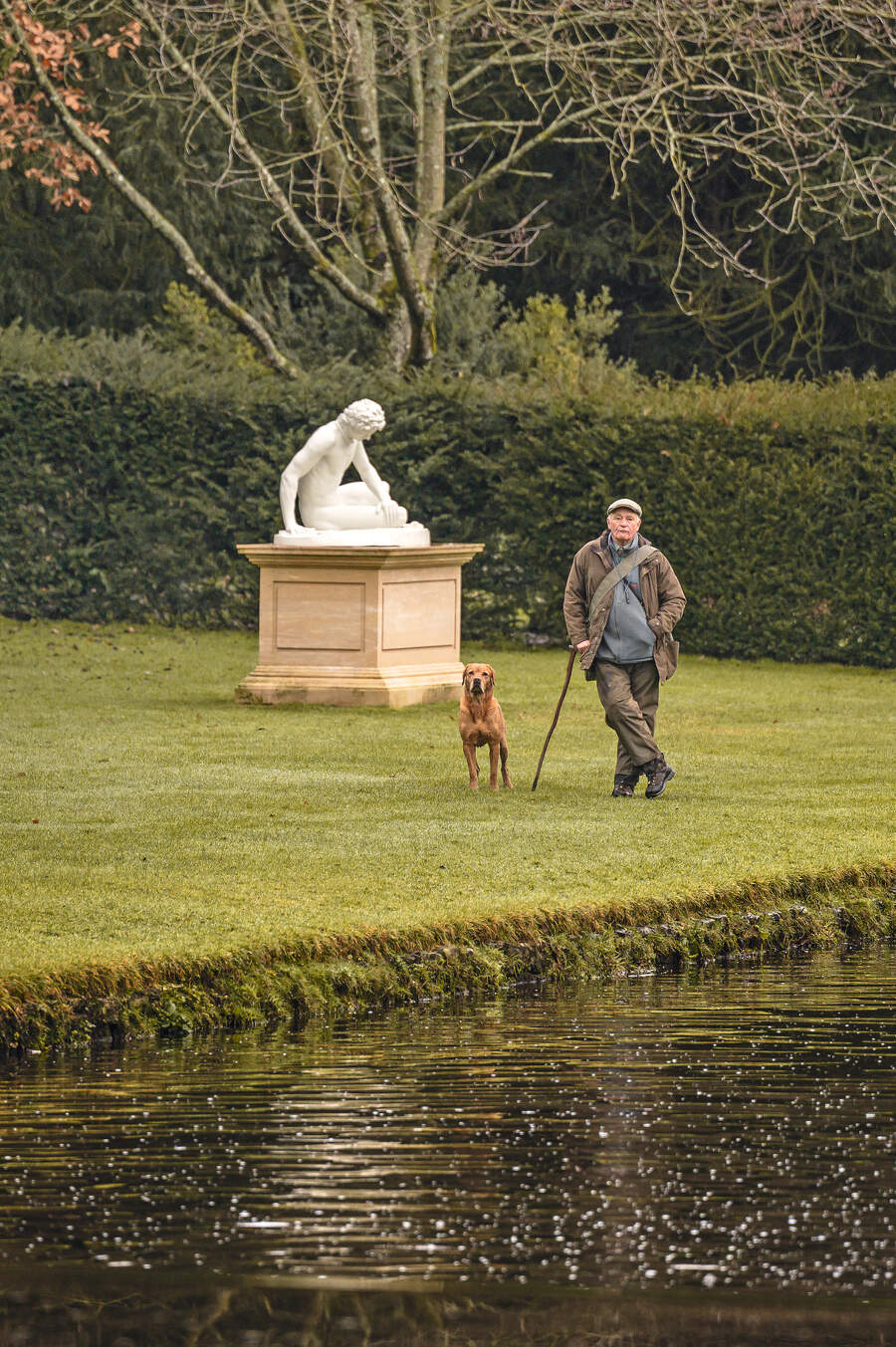
A picker-up in position among the statues of Studley Royal
“You could shoot with your slippers on here,” observes long-standing syndicate member and mine host at the Baxter Arms near Doncaster, Alan Clarke, as guns line out for the Canal drive with their backs to the Temple of Piety. The best birds spiral high and curl back into the drive, presenting challenging shots, but those taking on the wide valley offer easier pickings and several splash noisily into the water, much to the delight of Andy and Sue Ball’s gundogs, Bertie and Jess, the latter a black-mottled springer, the former an eye-catching Pennine pointer. “You’ll know their names all right by the end of today,” Sue jokes as she stoops to accept one of her husband’s birds from the water. “Working the dogs is a big part of the day for us.” The couple, who are taking it in turns to shoot alternate drives, are the only guests to have brought their own gundogs to supplement five professional pickers-up. These include retired electrician Bill Dockray and Paul Stogden, who has an open field trial winner among his team of seven labradors.
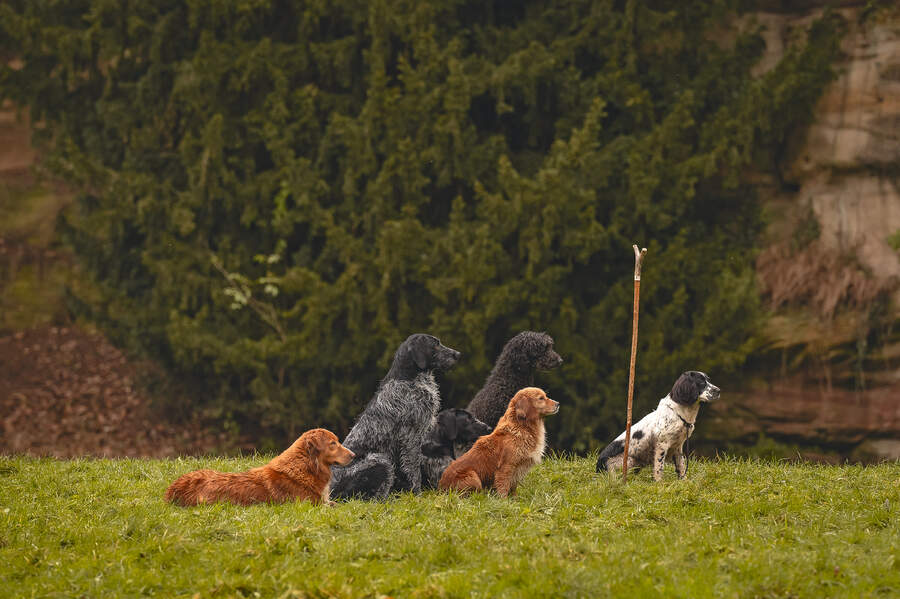
Professional pickers-up provided dog power in abundance
Guns are asked to be selective during the final drive of the morning where the Octagon Tower rises above thickets of dense yew and a small residue of taller trees that remain following a heavy thinning. This used to be an excellent drive before much of the mature timber was removed but Dave Roebuck and senior syndicate member Chris Tonkinson perform well on higher birds at the end of the line. Helen Roebuck is loading for her husband but Tonkinson, a former timber merchant who claims Donald Trump as a distant relative, is shooting with two guns expertly handled by his loader, former Newby Hall headkeeper Terry Jessop. “Terry has been with me since I first started here,” explains Tonkinson. “In those days everyone brought a loader but not any more.” In fact three of the guns on this relaxed and friendly shoot are accompanied by professional loaders, while others have pressed family members or spouses into helping.
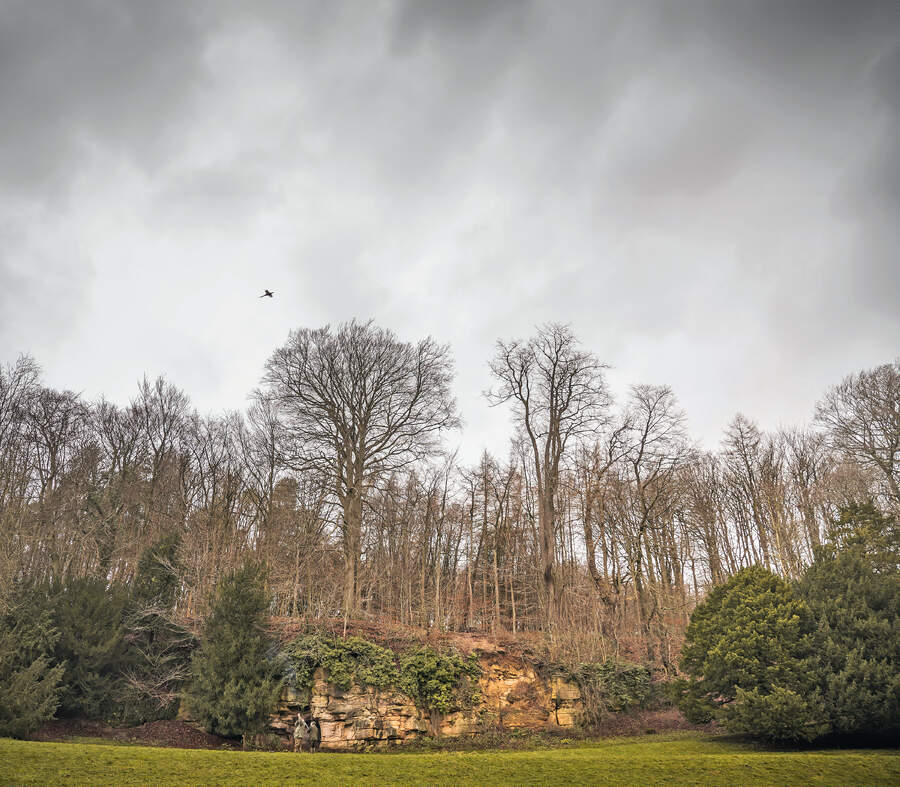
A fine shot by Chris Tonkinson
Lunch is taken in a restored dovecote at the Pheasantry, a welcoming space where former pigeonholes house bottles of wine and a hyena’s mask glowers from the wall above a caricature of the Marquess and a record of his career tally of game. Annalisa Fenton, who had been picking up with her energetic cocker spaniel Woody, left us after the second drive to rustle up a tasty pheasant dish for lunch, after which it’s time for the grand finale. “This was once the centre of the universe,” Julian Fenton points out as we arrive beside the imposing but sombre ruins of Fountains Abbey, where the graves of more than 500 monks were discovered in 2016. The Abbey fell victim to Henry VIII’s dissolution of the monasteries in 1539 but the macabre remains are dominated by a spectacular stone tower that was added on the orders of Abbot Marmaduke Huby in the 15th century. In his seminal work, The Big Shots, Jonathan Ruffer reveals that in Ripon’s day any bird flying above the tower (52 yards high according to Fenton’s rangefinder) was considered to be out of shot. I ask the headkeeper if we will see a bird killed at such a height in either of the next two drives. “I wish,” chuckles Andrew Richards wistfully, “but I’ll leave that for you to decide.”
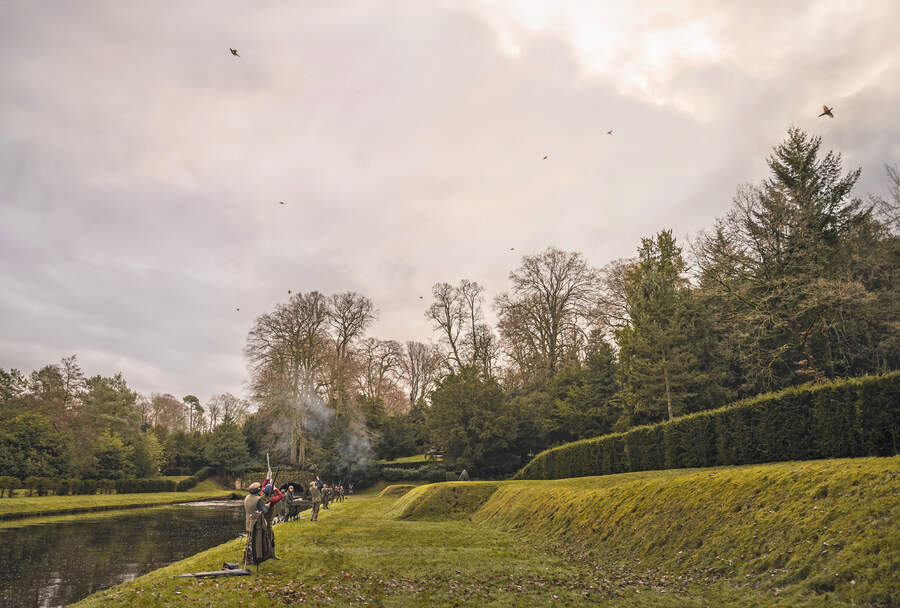
Duly refreshed, guns turn their attention to the birds on Canal drive
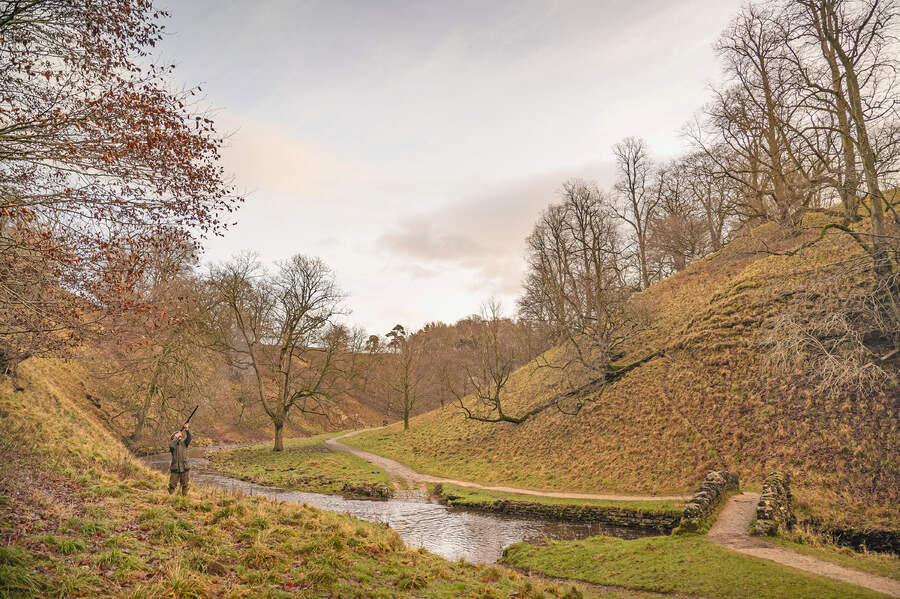
Alan Clarke on Seven Bridges
As it transpires guns do not get the opportunity, although Alan Clarke comes close when he knocks one of the best out of an angry sky. Although it’s only 2.30pm on this mid-December afternoon, dusk is creeping closer as beaters line out for the final return drive at Kitchen Bank, but for the first time during a truly breathless day we can feel a whisper of breeze getting up from the west and birds fly higher and faster than during any of the previous drives. The guns rise to the challenge but, however good the shooting, it is the timeless and awe-inspiring setting that steals the show. As Clarke affirms when it’s all over, “We’ve been coming here for over 15 years and still find it special.”
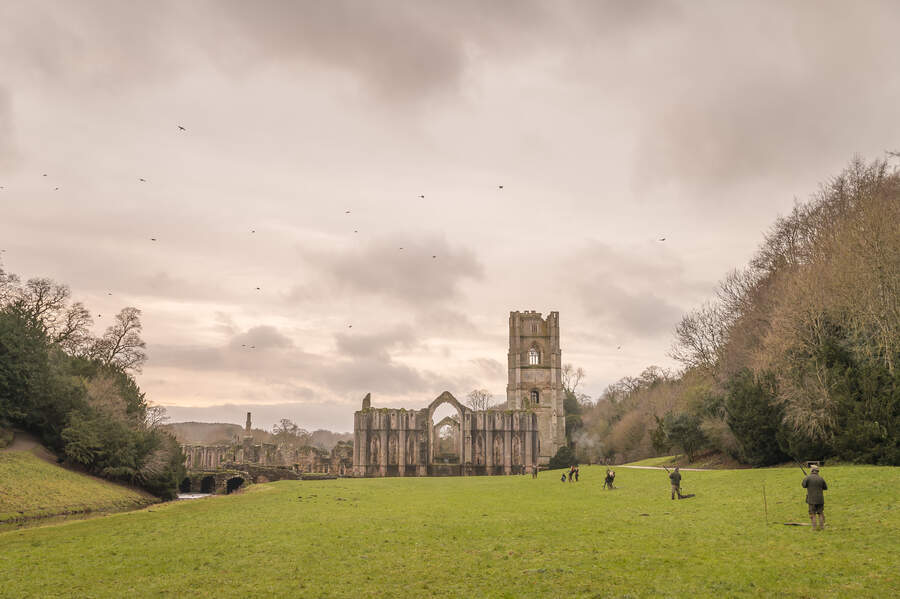
The final drive unfolds against the awe-inspiring backdrop of Fountains Abbey