



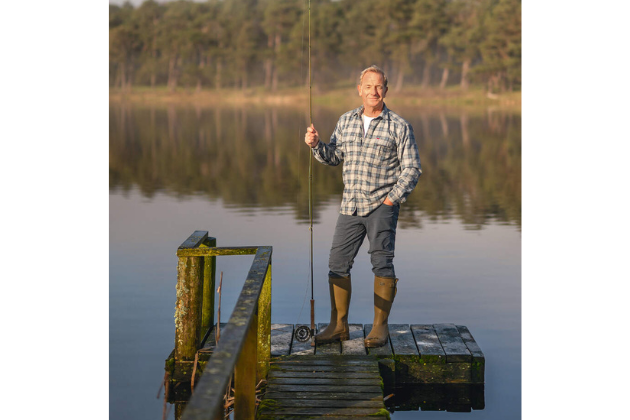
The Grantchester star sits down with Charlotte Reather to reflect on his multifaceted career, his deep love of rural life and the peace he has discovered on the riverbank
Sixteen years ago, I met actor Robson Green at the Radisson Blu Edwardian Heathrow during a cage-fighting event. Dressed for a hunt ball, I fought my way through a sea of meatheads, flavoured with the fug of sweat mixed with cheap cologne, to secure an interview for The Field. At the interview, Green offered to buy me lunch; I agreed if he promised not to sing.
“So you don’t like my singing?” he asked, mock-offended. “I’ll have you know Robson & Jerome had three consecutive number ones, a number-one album and kept Michael Jackson off the top spot in the charts.” Little did I know that he and Jerome also made Simon Cowell his first million. “A woman once told me she’d got our CD free with a chicken at the supermarket. She didn’t care much for the music but she kept the CD cover under the fridge to stop it wobbling.” He spreads his hands. “That’s where we ended up. We stopped the fridge from wobbling.” And somehow, the Unchained Melody crooner hypnotised me with his blue eyes and co-opted me into co-writing a book about his television series Extreme Fishing.
Shuttling from grandiose to self-deprecating, Green has always used humour to mask vulnerability. He’s also someone of unabating restlessness. “I wake up now and the first thing I think is, ‘Great, I didn’t die,’” he says, deadpan. “And then I try to put my socks on and realise I’m making noises I never used to make.” He grins. “That’s 61 for you. I used to be a juggernaut, filming and fishing for 18 hours a day. Now I have to be economical with my energy. When the red lights flash on the dashboard, I know I need a recharge. Like a Formula One car without the glamour.”
Love of the countryside
What hasn’t dimmed is his love of the countryside, passed on to him by his Uncle Matheson – both true constants in a life lived at breakneck speed. “Being immersed in the countryside and the benefits that nature gives you is food for the soul,” he says. “Living here in Northumberland, in the heart of rural life, it just makes me feel better. I live close to the tributary where I was spawned, although I didn’t know it at the time,” he says.
Back in 2013 he was house-hunting near Hexham with his mother, whose health and memory were fading. “I didn’t even really look at the house,” he laughs. “It was all about the river: a two-mile beat where the north and south Tyne converge, and a holding point for spawning Atlantic salmon on their arduous journey.” Then his mother surprised him. “She said, ‘This is where you were born, Robson – just up the road.’” Like the salmon, Green had instinctively returned to the backwater in which he was born.
It is here that he and his partner of 10 years, Zoila Brozas, fly-fish together. “Spending 90% of my time on a film set I suffer terribly from cabin fever,” reveals Green. “I was looking at the river this morning thinking, ‘Get yourself out there. The colours are beautiful.’ And when I’m out, nothing else exists. I’m at peace with myself as I cast. It brings out the calling of our forefathers – the hunter-gatherer in us.”
According to Green, the rhythm of fly-casting was introduced to him by his Uncle Matheson to the music of Johann Strauss: “Because it’s a waltz.” Matheson first took him fishing across the border in Scotland. “I was 14,” Green recalls. “We were at Union Bridge on Tweed and I caught an eightpound salmon on the fly. Once he got me into fishing we became best mates,” he continues. “We still fish together on Coldingham Loch, the River Tyne and Derwent Reservoir.”
Matheson also taught him the gospel of gundogs: one-syllable names only. “Jim, Don, Tom. They react quicker. Jim’s 16 now and bright as a button. They were all brilliant working dogs.” Green enjoys pigeon shooting and a few let days locally. His first driven pheasant shoot remains seared into his memory. “A big flush of pheasants came over the line of guns and I panicked – I fired but was completely useless,” he laughs. “On the second drive, a lovely high bird came over. I was terrified but I got it. And suddenly I felt part of the gang.”
British Columbia
However, it is the river where he is most content, and for a man who has fished much of the globe there are many standout adventures. “The Skeena River in British Columbia is one,” he says. “We started at the estuary and saw 45 humpback whales. Luckily I’m a good enough fly-fisherman to get at the salmon. I can double-haul. In a week I caught 131 salmon; Zoila caught over 200. She outfished everyone. She’s a brilliant caster.”
His son Taylor, 26, fishes too. “We went on a father-and-son trip to Corrientes in Argentina to fish for golden dorado. We saw capybara, caiman, an array of birdlife: everything that’s good about fishing in the wild. No cameras. No pressure. I wrote my will the other day,” he muses. “They asked where I’d spend the rest of my time, and I realised it’s at home in Northumberland. The countryside gave me balance when I lost it and I will end my days here.
“Besides,” he adds with a wry smile, “Grantchester has ended.” He elaborates on the long-running series while at a talk in Cambridge where he observed, quite reasonably, that there had been 78 murders in Grantchester, and the vicar – not his character, Detective Inspector Geordie Keating – had solved 77 of them. “I said, ‘That technically makes me the worst detective in television history.’”
Sixteen years ago, Green told me fishing made him feel like himself. Sixteen years on, he is still happiest up to his waist in water, rod in his hand, watching clouds drift across the surface of the Tyne while Zoila reels in another beauty. His competitive edge dulled; his restlessness in part replaced by contentment and genuine peace.
Read more Field interviews here.
Photograph by Duncan Ireland.