




This new German-made straight-pull hunting rifle has earned a considerable reputation since its launch last year. Michael Yardley finds out why
Mauser 25 Pure

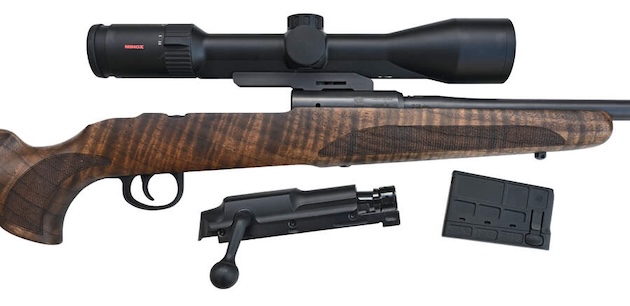
The Mauser 25 Pure is an innovative straight-pull design combining Mauser aesthetics with modern German engineering. Cleverly conceived and accessibly priced, it will inevitably be compared with the premium Blaser R8 but impresses in its own right. It is supplied here for test by Blaser UK with a rail-mount Minox 2.5-10×50 telescopic sight and a Sauer Titanium sound moderator: weighing in at 8lb 6oz with the scope (midweight) and just over 9lb with the silencer added. This gun has an ambidextrous grip with slight palm swells – a dedicated left-handed version is offered at no extra cost. The pleasantly figured walnut stock has an oillike finish and is otherwise conventional (synthetic and thumbhole options are also available). Length of pull is 14¼in with a synthetic black pad, while the grip and rounded fore-end are laser chequered.
Mauser is part of the Blaser Group, which now includes Blaser, JP Sauer & Sohn, John Rigby, Minox and Liemke. Blaser acquired the specific rights to the Mauser brand in 2004, and the latter’s hunting rifles are manufactured by Blaser/L&O at Isny im Allgäu in southern Germany. Blaser and Mauser operate as distinct brands aimed at different markets. As you put the new rifle through its paces, however, the excellent Blaser straight pull cannot help but come to mind (as does the short-lived Mauser M96).
Mauser is, of course, famous primarily for its bolt-action rifles. It developed the legendary Model 98 (Gewehr 98) and, much more recently, after various corporate reshuffles, the highly successful M12 introduced in 2013. The new straight pull seems to be targeted at similar buyers. First impressions are certainly good – the Mauser 25 is a businesslike modern rifle with classic lines. The finish is practical: the floating hammer-forged barrel is plasma oxide-coated and everything else is nonreflective black. Bolt shroud, magazine and trigger-guard are black polymer.
Initial set-up was delayed slightly due to unfamiliarity with the novel bolt assembly and quite how its rails fitted the (aluminium) receiver. This was quickly overcome. On first cycling the rifle felt exceptionally fast, and the operation of the well-positioned bolt is super smooth. There is a notable absence of friction once it unlocks (which requires around 1/2in of initial rearwards movement). The bolt is a non-rotating design with two tilting lugs and a locking wedge forward that pushes the lugs into battery. Lock-up is reassuringly solid. This is a non-rotating bolt design like the Blaser R8 and R93 from which it evidently gets some inspiration, although the Blasers dispense with lugs and have a radial collet that expands into a circular barrel recess. Mauser calls the new 25’s simpler system ‘Mauser-Spread-Lock-250’.
What of the straight-pull’s historical development? The first successful design was the Mannlicher M1886, employing a dropping wedge to its bolt’s rear camming on a hinged flap. The 1895 Mannlicher opted for rotating lugs, while the Swiss Schmidt- Rubin had a rotating bolt sleeve with rear lugs (1889 and 1896 models), amidships (1911 model and K11 carbine) and to the front (K31). The Canadian Ross rifle used an interrupter thread like an artillery piece, and the M1895 Lee Navy employed a curious tilting bolt with a steel wedge locking beneath it.
Modern guns include the Blaser R93 (introduced in 1993) and the R8 that replaced it in 2008 (although the models coexisted for several years). Both employ a 14-lug radial collet locking but the R8 has additional safety features, including an improved collet able to withstand even higher pressures. The Savage Impulse launched in 2021 features a rotating bolt and ‘Hexlock’ where six hardened steel balls at the front of the bolt head expand outward into the barrel extension. The Merkel Helix and Browning Maral also have rotating bolts. The Merkel has six lugs locking into the barrel; the fast-cycling Browning has seven, and adapts the BAR’s (Browning Automatic Rifle) return spring mechanism. After pulling the bolt back manually, the spring automatically drives the bolt forward.
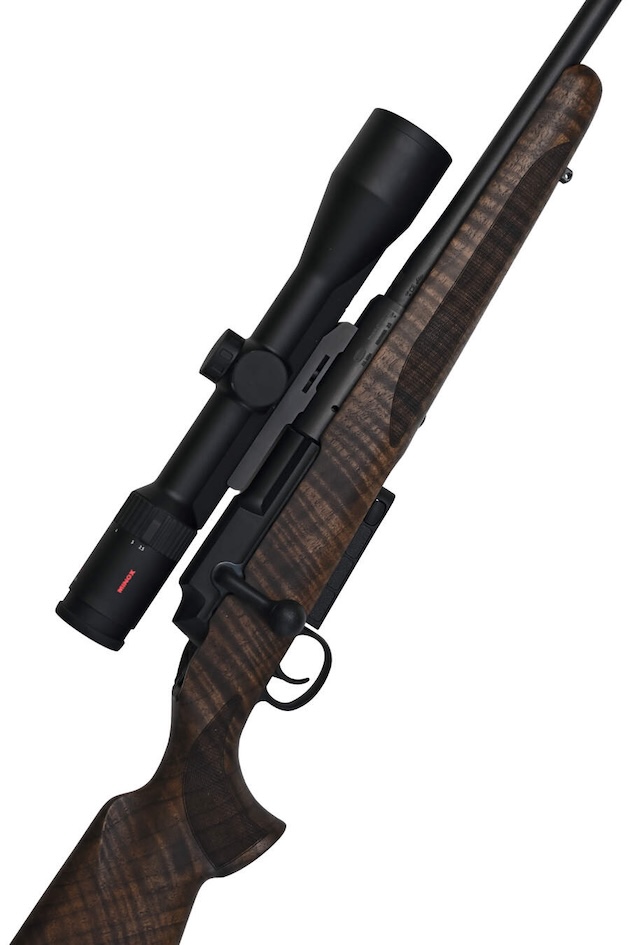
Boasting classic lines and a practical finish, this gun inspires confidence
Technical
The Mauser 25’s action has a pivoting single-action hammer (cocking on opening) within a simple single-stage direct trigger mechanism. Dispensing with a conventional striker system, it loses the need to compress a heavy striker spring. The hammer is light and thin; the trigger engages directly into it with a simple sear on the back, allowing for a clean pull and reduced mechanical complexity. A non-rotating bolt travels along rails in a milled-alloy chassis, providing rigidity and smooth operation. Ejection is accomplished by two springloaded studs on the bolt face. Rather than rotating into battery, the bolt head uses a clever ‘Spread-Lock’ system as noted. Twin bolt lugs are pushed by a central bolt wedge into respective recesses on the barrel extension; the bolt then rests slightly further forward. Although the receiver is machined alloy, the steel bolt locks into barrel steel. The alloy receiver primarily acts as a carrier for the stressbearing steel components. Operational friction is low but locking-lug contact areas exceed those of the famed 98.
Shooting impressions
Launched in 2025, this Mauser has already gained a considerable reputation. Accuracy on test was reassuringly consistent with a variety of 150gr and 168gr loads averaging one minute of angle or better. Cycling was butter smooth, and recoil well controlled. Breaking at around 2lb, the trigger was exceptional; the two-position sliding safety was positive and silent too. The well-shaped bolt may be brought back for unloading or loading with the safety still on by depressing a latch on the top of the thumb-piece. The Mauser 25 can be single fed into the chamber as well but the magazine must be removed for normal reloading. The standard singlestack magazine has a capacity of only three rounds. There is a five-shot version available – useful for boar – which protrudes slightly more. Overall, the gun inspires confidence and will create more straight-pull converts.
Sauer Titanium moderator £593; Minox RS4 2.5-10×50 £632; rail mounts £178 (other scopemounting options available)