





Despite their impressive capabilities, HPR breeds are still viewed with suspicion on some formal driven shoots, as David Tomlinson explains
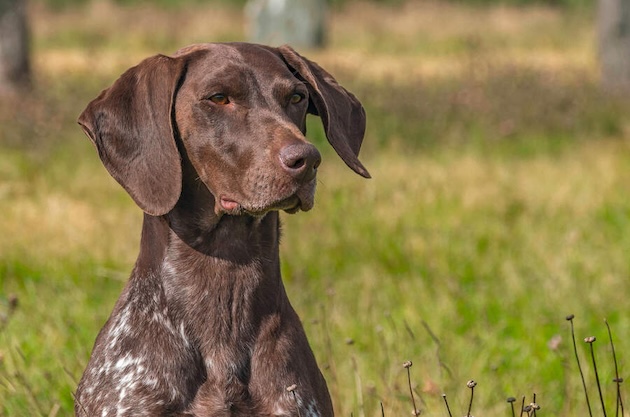
The German shorthaired pointer is the most numerous HPR breed in the UK
Your first day’s driven shooting is invariably memorable. However, for one friend of mine this was for all the wrong reasons. The much-anticipated outing dawned cold and frosty, and it was still dark when he loaded up his elderly Land Rover with gun and dog. Unfortunately the vehicle refused to start, so he switched to his banana-yellow Porsche 944, with Gustaf the weimaraner sitting proudly on the front seat. In his haste, directions to the shoot were left in the Land Rover, and this was long before the days of satellite navigation.
Three wrong turns meant that he arrived late. Guns were ready and waiting, so watched with interest as the yellow sports car squealed into the yard. In his haste, Gustaf emerged without his slip lead. Almost at once the keeper’s black labrador launched an attack on the unsuspecting weimaraner and a noisy fight ensued. “It was a bit like a re-enactment of a Second World War battle, with Britain versus Germany,” my friend recalled later. The combatants were eventually separated but there was no word of apology from the keeper, who claimed that his dog had never seen a “bloody German HPR before, so what do you expect?” It was an inauspicious start to the day. (Read this guide to HPR breeds.)
Continental HPR breeds
There remains a taboo around turning up for a formal driven shoot with anything other than a retriever or spaniel. Many people continue to eye the Continental hunt, point, retrieve (HPR) breeds with suspicion and struggle to identify any aside from the German shorthaired pointer (GSP). I used to pick up on a shoot where the keeper worked Hungarian wirehaired vizslas. Visiting guns never knew what breed the ginger dogs were, so we would tell them that they were Norfolk lurchers. None queried the identification. (Read more on
Hungarian wirehaired vizslas are just one of 17 breeds of Continental gundogs that are recognised by the Royal Kennel Club. Some, such as the Korthals griffon, German longhaired pointer and bracco Italiano, are so rare that it is unusual to encounter one in the shooting line. Of the 17 breeds, eight typically gain fewer than 100 puppy registrations in a 12-month period, while all have seen a decline in registrations over recent years. The most numerous is the GSP, and there’s a good chance that a reasonable percentage of the 1,313 puppies recorded in 2024 went on to be trained as shooting dogs. If you ignore the extraordinary blip in registrations in 2021 as a result of COVID- 19, then the number of GSP puppies born each year is reasonably constant. This contrasts strongly with most of the other breeds. For example, 1,171 weimaraners were recorded in 2015 but in 2024 it was only 629. (Read: the best gundog breeds from overseas.)

A Korthals griffon on the moor. Like other Continental breeds, these dogs are a rare sign in the field
One thing is certain: if it wasn’t for the enthusiasm of the showing fraternity, many of the Continental gundog breeds would soon disappear from this country altogether as so few people work them. It could well be that the inbuilt conservatism of the shooting world has contributed to the fact that one still sees relatively few of these breeds regularly out in the field. However, several have found their own specialist niches. Many stalkers, for instance, employ German wirehaired pointers, while there are plenty of rough shooters who would have nothing else. Falconers favour Brittanies, as they are dogs that generally prefer hunting to retrieving. However, with just 22 Brittany puppies registered in 2024, finding a good one is becoming increasingly difficult.
I have shot over, photographed and watched working almost all of the Continental breeds, and I’ve seen some terrifically capable and impressive dogs. But I’ve also come across some shockers. These included noisy dogs, some with mouths like crocodiles (in Germany a hard mouth is not considered a fault, as their dogs are encouraged to tackle foxes or even boar) and others that wouldn’t retrieve or swim. It could be said that these dogs deserved better handlers but there were certainly many that simply lacked ability. Owners of working HPRs tend to have a special enthusiasm for their chosen breed, having made the conscious decision to opt for something other than a retriever or spaniel. Intriguingly, a high percentage of the owners that I have met weren’t from a shooting background. They’d acquired their dog as a pet or for showing, discovered its potential as a gundog and become keen to work it. Several had trained their dog to a high standard but with a lack of connections in the shooting world had struggled to find anywhere it could perform. (Read: how to take an HPR shooting.)
It would be good to say that prejudice against HPR breeds has declined in recent years and that more shoots welcome these breeds, but that’s not the case. You might see the odd German pointer, vizsla or weimaraner in the beating line but they remain a rare sight at the peg. Labradors may not be as popular as they were but their place has been taken by cockers, not German pointers. Incidentally, my friend persevered with Gustaf but when he died he acquired a labrador, and he is now on his fourth black dog. Says it all, really.