




Patrick Grant the Great British Sewing Bee judge, former Savile Row tailor and founder of Community Clothing talks to Amanda Morison about nature, scything and sustainable fashion
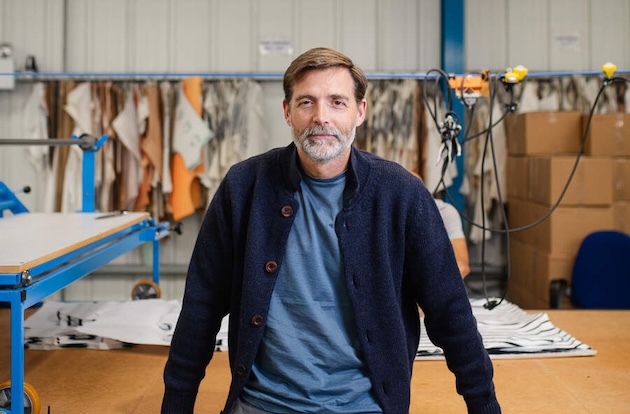
Patrick Grant goes through life at quite the clip. Brought up in Edinburgh, he played rugby for Scotland at under-18 and under-19 levels. An injury ended his career but not his love of adrenaline, and after graduating from the University of Leeds in materials science he worked in Vail as a meeter and greeter. The hours weren’t long, which meant a lot of time for skiing, plus a free ski pass and early access to the slopes.
Now 53, Grant says he’s always had a lot of stamina. Nowhere is this more obvious than in his work ethic, learnt from his father “who on his days off would spend 10 hours digging in the garden”. When at Cookson & Clegg, the Blackburn clothing factory he saved from closure in 2015, Grant gets to his desk at about 7am. He often works 12 hours straight, yet this is nothing compared with the 100 hours a week he packed in a few years ago when running Savile Row tailor Norton & Sons, designing the Hammond & Co range for Debenhams plus writing two books. “My girlfriend wasn’t mad keen on the book writing, it’s fair to say,” he admits.
Community Clothing, which was launched by Grant in 2016, sells plastic-free clothes sustainably produced in the UK from fabrics made in Britain and designed to last. At its core is a mission to not just help the planet but also communities by creating skilled jobs, and restoring prosperity and pride in towns – such as Blackburn – that were the beating heart of Britain’s textiles industry. It’s the antithesis of throwaway fashion.
“I wear the same stuff pretty much all the time, obviously with fresh pants and socks,” Grant clarifies. This ethos was behind his second book, Less, the strapline for which is ‘Stop Buying So Much Rubbish: How Having Fewer Better Things Can Make Us Happier’. It followed a TED Talk he gave deploring modern consumer culture. “We’ve created a society consuming incredible quantities of low-quality goods that are made elsewhere by people who get little financial or emotional reward,” he says.
He doesn’t hold back about the companies that he believes do little good for the world: “I don’t shop at Zara or H&M, and don’t get me started on Amazon. I don’t want to give money to a man who so patently doesn’t give a damn about anybody who works for him. I mean, what kind of berk hires Venice for his wedding? When people are dying of starvation, it’s just so uncool.” Using language that wouldn’t make it on to the cosy confines of The Great British Sewing Bee, the BBC show on which he is a judge, Grant blames successive governments for thinking our industrial past is behind us: “The country needs jobs. By the end of 2025 Community Clothing will have created over half a million working hours.”
We have the power as individuals to fight over-consumption by being more thoughtful about who we give our money to, believes Grant: “I buy my bread from Beth and Sam at the Ambry Bakery in Settle. I want them to have my cash, not Sainsbury’s.” He feels some positivity about the way things are going with food but finds it odd that the same people who are happy to spend £15 on a chicken don’t think about the implications of paying just £5 for a dress. “We have become used to immediate gratification because companies do such a brilliant job of making us buy stuff that we don’t really need,” he says.
Certainly there’s little that’s new in his home, a Grade IIlisted house near Settle with a ha-ha and walled garden. It hadn’t been occupied for 25 years when he bought it. The furniture was all sourced on eBay, at auction and even salvaged from skips. “Some of the beds are from Royal Warrant-holding furniture makers. They’re 100 years old and there’s every chance they’ll last another 100,” Grant declares. Two pigs, Tamworth and Oxford Sandy and Black crosses Acorn and Hazel, help keep the garden under control by rooting up brambles and nettles. He’s sad not to have the time to own a dog, though enjoys making a fuss of a local St Bernard-Alsatian cross owned by those who repair his mowers. “He failed his police dog training for being too nice,” Grant explains.
He has a keen interest in garden tools. “I have my late father’s, arguably the most precious things I own. I’ve recently learnt to scythe. It’s such a quiet sort of connected activity because you can hear and see everything. With a mechanical strimmer you wear a visor and ear defenders and don’t see the wildlife until it’s too late,” insists Grant, who earlier this year became a patron for the Craven Wildlife Rescue. “There are a horrific number of hedgehog strimmer injuries,” he reveals.
Since becoming a judge on the Sewing Bee Grant has become a very recognisable figure but he’s sanguine about fame: “The kind of people that watch our show are on the whole super-nice folks.” He loves the process of filming: “We have a great time with everyone, the producers and all the contestants.” While he is strict about not getting too close during filming because of bias, he and fellow judge Esme Young often get to know contestants when the series ends because they’ll bump into each other at events such as the annual Festival of Making, which Grant attends every year. (You might like to read our article on repairing vintage fountain pens.)
With strong views and a high profile, you might think he would go into politics but it is an emphatic ‘no’. He’d rather simply practise what he preaches. This is clear in his business enterprises and in how he throws himself into local activities – he entered four categories at this year’s Austwick village fair. He’s also an ambassador for The King’s Foundation and was installed as chancellor of Edinburgh’s Queen Margaret University earlier this year. Quite the busy sewing bee – with half a million hours behind him to prove it.