



The trailblazing trainer talks to Lucy Higginson about her triumphs on the turf, building resilience through hunting and why forging a connection with horses is essential
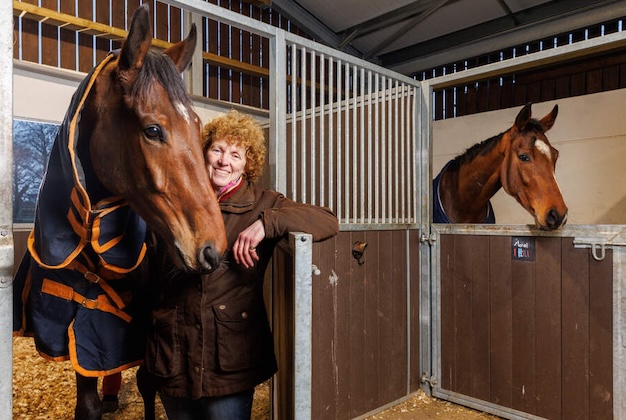
Racing presenters roving the pre-parade ring are never happier than to spot Lucinda Russell. With corkscrew curly hair and time for everyone, no one exudes more enjoyment for their sport. A licensed trainer now for 30 years, with 1,095 winners to her name, Russell is one of only two Scots and four women to have trained a Grand National winner, and (with Jenny Pitman) one of only two to have done so twice – with One For Arthur in 2017 and Corach Rambler in 2023.
With Michael Scudamore (the son of her partner Peter Scudamore, and her assistant trainer of the past two years) having joined her last August on her trainer’s licence, and her 60th birthday coming up in June, thoughts of slowing down have not entered her head: “I still think I can get to the top – you have to have that drive.”
Russell was born to a distilling family in Edinburgh and not thrown aboard a pony as a toddler, like so many of her contemporaries, but begged for years to ride. Her experiences with the Fife Pony Club and the local hunt furnished her with the resilience that’s essential for any life in horses. After university she began taking other people’s cast-offs (“I lied to my father that it was a gap year before getting a proper job”) and turning them into event horses, selling them on once qualified for Badminton. “I couldn’t help myself,” she admits.
When asked which horsemen in history she’d use a Tardis to visit, Russell nominates showjumper Ted Edgar and eventing coach Lady Hugh Russell. “They were true horsemen of the 1970s and 1980s… I like the people in eventing and think we should share ideas a lot more; I keep telling Piggy [March – a Badminton and Burghley winner] she should come to see the yard.”
The yard Russell developed at her family’s Arlary House in Perthshire now stables 160 horses that she feeds herself (“my favourite time of day”) before riding out two or three lots. All of this enables her to get to know her horses intimately and in the round. She says of her beloved National winner Corach Rambler, who’s still in training but whose racing days are over: “He didn’t want to go around the National again but he loves going out with the string and taking the mickey out of Scu. He’s a remarkable horse to be so sensitive; he can judge people, he can judge situations.” And how does she look for that competitive urge in a horse she’s thinking of buying? “It just comes from knowing a lot of different horses, and I’ve known thousands.”
Similar instincts come into play when rehoming horses after racing on permanent loan to the right homes to be hunters, riding horses and so on; something Russell is extremely good at. “I’ve never had an owner who said ‘I want money for my horse rather than a good home for it.’ There is a lot of money in this sport but it’s put towards the horse.”
As a big supporter of hunting, for a time she was even involved with running a local hunt. “It was brilliant fun, just like a Christine Pullein-Thompson book,” she remembers. “One friend kept a couple of hounds, I laid the trail and another friend was Field Master. We used racehorses; hunting builds resilience, teaches you to make good decisions and love your horse. But I fear for its future.”
Our increasingly urban population is another worry. “We have to keep people coming in and seeing our world; people are too quick to criticise without knowledge,” she says. Nor does Russell shy away from reasoned discussion about welfare in racing. She speaks animatedly about this, the care of the modern racehorse and the diverse ways to sample the experience of ownership, making it accessible far beyond the elite: “I’ve met some phenomenal people in racing – kings, queens, gangsters and everything in between.”
Like many top competitors, Russell is perpetually learning and looking for a strategic advantage. “I like speaking to vets; I’ve been to a few vet conferences lately,” she reveals. But she never forgets the key ingredients that have been unchanged for centuries: well-planned exercise, good feed and riders, and clear air. Even the Kinross gales she deems useful for maintaining sound wind. Russell is absolutely committed to turning her horses out regularly to live as natural a life as possible, despite the potential risks.
“Knowledge is a fantastic thing but ultimately you just have to go back and look at the horse, try to keep them as sound as possible and prepare them as best you can. From my point of view, racing is actually quite easy because galloping and jumping is what they’re naturally meant to do,” she insists.
It’s too early in the season to tell whether Russell will have a runner in this year’s Grand National but winning a third one is a huge ambition. No other woman has done it, and Aintree’s more northerly meeting, rich in Scudamore family history, has always been the ultimate for a Scottish girl who used to stick Red Rum posters above her bed. (You might like to read: how amateur jockeys made the Grand National the race it is today
Though she is proud of her team at home, the horse and better understanding the animal is clearly the thing she loves best: “It doesn’t matter whether you’re feeding a horse at the side of the road when you’re eight years old or if you’re training the Grand National winner, it’s just about that horse and your connection with it.”