



Charlotte Mackaness meets the women at the helm of four of the countryside’s best-loved
fashion labels to learn how their experiences have helped shape their brands
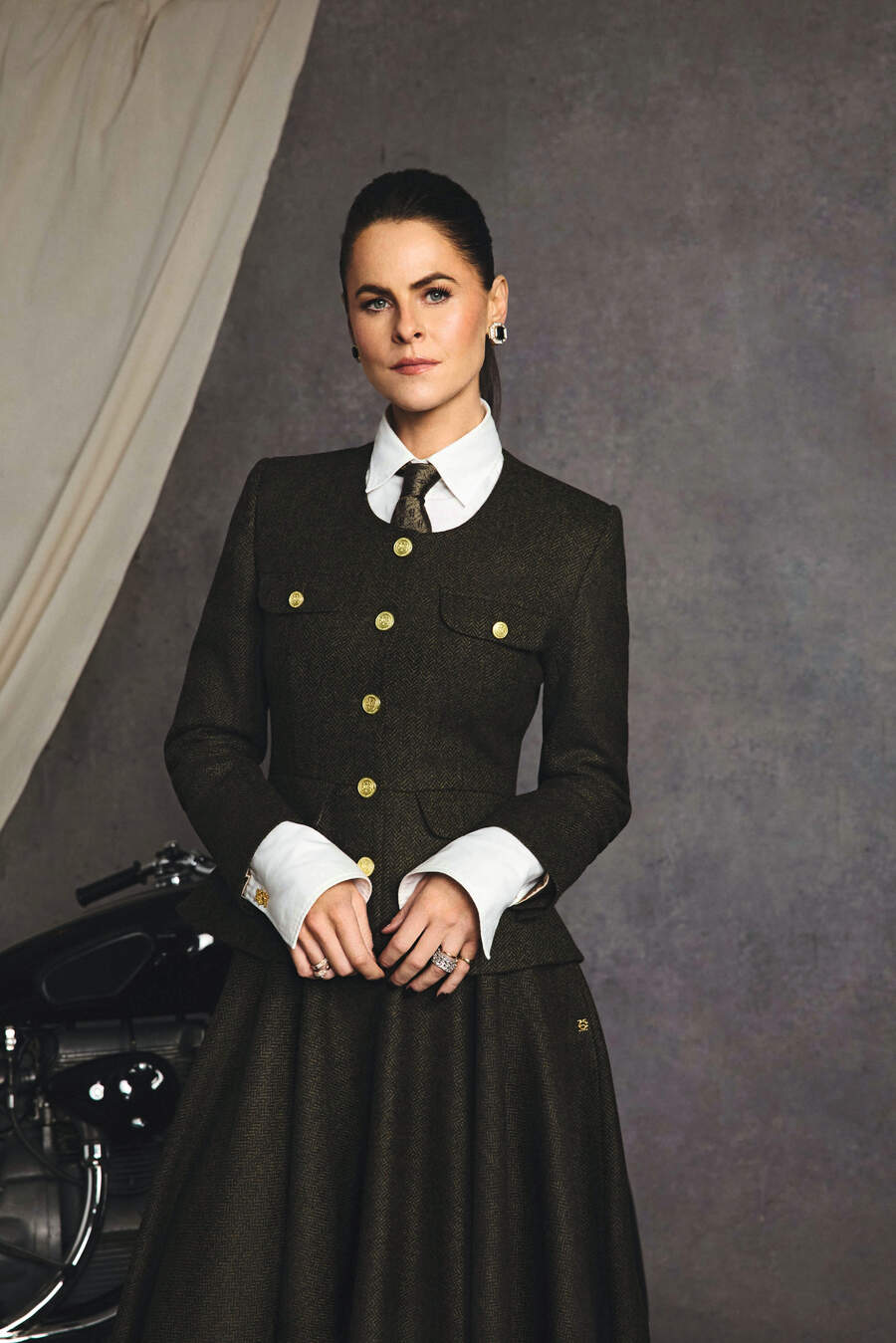
Jade Holland Cooper
Jade Holland Cooper, Holland Cooper
Fashion and the countryside have always gone hand in hand for Jade Holland Cooper, who grew up on a farm. In fact, she turned down a place at Central Saint Martins to go to agricultural college. “British heritage and the countryside are the influences that became the foundation of the brand, which I started while still a student,” she reveals, while citing her mother as her biggest inspiration. “She was a designer, and I was fascinated by the way she worked, sketching, selecting fabrics and turning ideas into something tangible.”
Today Holland Cooper is based in a 70,000-square-foot, £10m headquarters in the Cotswolds but its origins were much smaller. “I began 18 years ago from a small trade stand at Badminton Horse Trials with just 30 tweed miniskirts that sold out almost immediately,” Holland Cooper explains. “In the early days I travelled the country selling at shows and events. It gave me a genuine understanding of what women wanted and that helped shape the brand.”
Her childhood on the farm, surrounded by horses, was also highly influential: “I know exactly what it’s like to spend long days at equestrian events, for example, balancing practicality with wanting to look and feel your best. Women shouldn’t have to choose between style and functionality,” she insists.
While Holland Cooper had a clear vision of what she wanted to create (a luxury British brand that championed exceptional craftsmanship, timeless design and quality) she did face difficulties, not least being underestimated: “I was young, building a luxury brand from scratch and I didn’t come from a traditional fashion background. There were certainly people who questioned whether it could be done,” she admits. “But every challenge became a motivation.
“I was also told that it wasn’t possible to scale the business while keeping our tailoring and production rooted in the UK. I was determined to prove otherwise. Eighteen years later and we’re still working with some of the same British mills we partnered with in the early days, and today I’m proud that we’re one of the country’s largest buyers of British wool and tweed. British craftsmanship is also incredibly important because it protects skills that have been passed down through generations,” believes Holland Cooper.
For her, tweed remains a favourite fabric. “It is iconic: not only rooted in British country life but also a true performance fabric. That combination of practicality, luxury and heritage is what defines Holland Cooper and it’s something I never compromise on,” she insists.
Something else Holland Cooper champions is being a female-led business: “Building a brand in a competitive industry requires strength and determination, and there have definitely been moments where I’ve had to be resilient and push through obstacles to keep the vision on track. Our office is 90% female, which creates such a strong, supportive and collaborative environment every single day.”
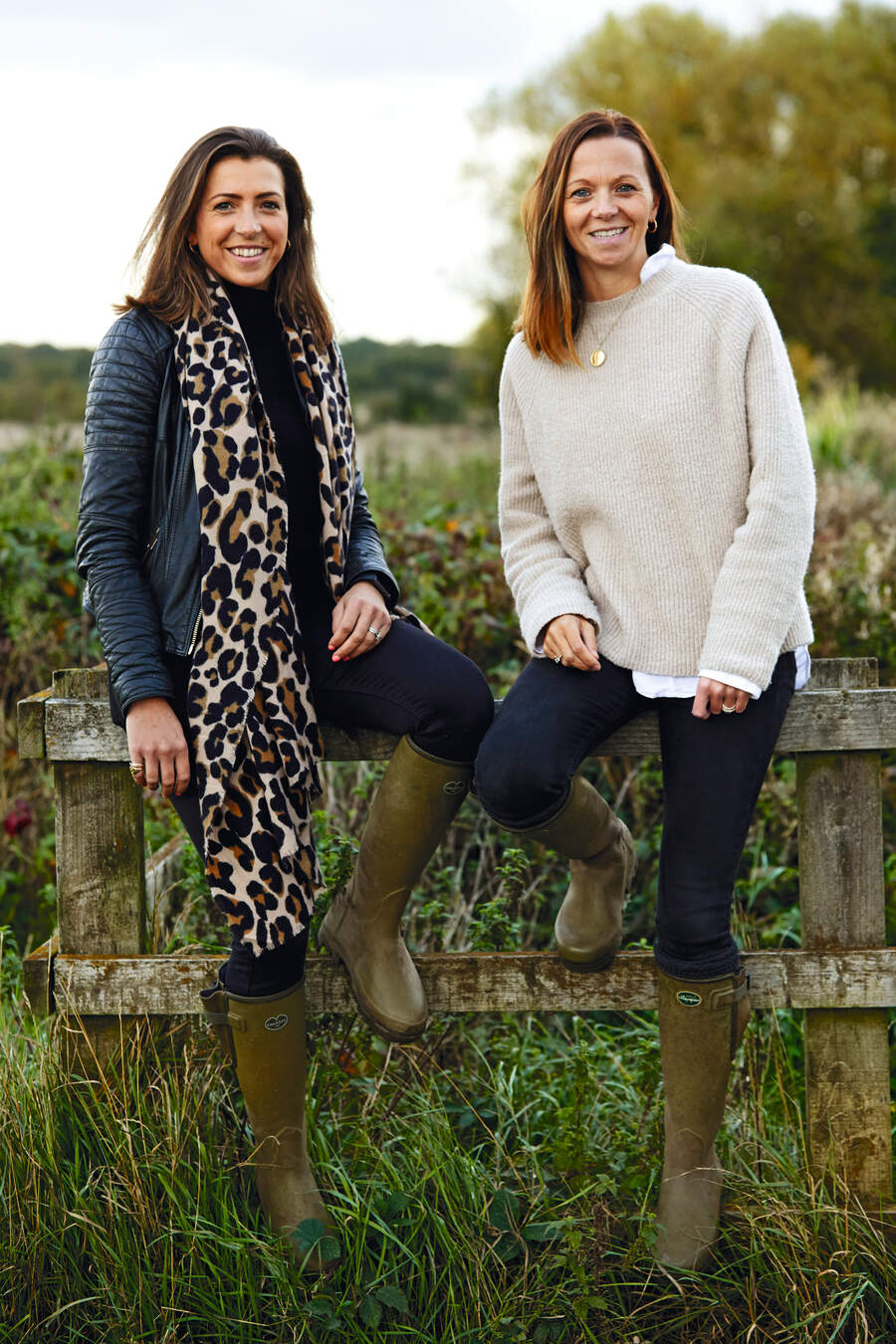
Rosie Turner and Alice Leet-Cook
Rosie Turner and Alice Leet-Cook, Hicks & Brown
“We never really think of ourselves as a fashion brand,” says Rosie Turner, one half of the sibling duo behind Hicks & Brown – a name synonymous with high-quality hats and accessories, especially fedoras. “We’re all about longevity and creating pieces that can be worn year after year.”
Ironically, her sister Alice Leet- Cook reveals that the pair fell into hats almost by accident. “Just over a decade ago we were making beautiful silk jackets – the sort of thing you might wear to a wedding – and selling them at point-to-points but we didn’t really have much of a clue what we were doing. Our mother suggested we bought some hats and customised them,” she explains. “Before long we were selling far more hats than jackets, and we’ve not looked back since.
Hicks & Brown is still based in Suffolk, where the girls grew up in a Field-reading, farming family. Although they did stints working in London – Turner as a bloodstock underwriter in the City, Leet- Cook for Savills – they both saw this as temporary and were drawn back to their roots. “In our hearts, we wanted to create something ourselves. As little girls we were always making bits and pieces; scrunchies that we’d sell for 50p and that sort of thing,” remembers Turner.
They have been inspired by their mother, who Leet-Cook describes as “an incredible seamstress who could alter or customise anything” and who still supports her daughters at shows. “We’re a small, female-led company and it feels much like a family,” she continues. “Having experienced corporate environments that were quite rigid, we’re pleased to give the women who work for us flexibility.”
According to the pair, growing slowly and organically has also been liberating. “I see it very much as an enjoyable passion project and still love what I’m doing,” says Leet-Cook. “We don’t have pressure from investors or any expectations.” Despite this modesty, Hicks & Brown is found in 80 stores across the country, with even some US stockists, while selling online and having a presence at events such as The Game Fair, Burghley and Badminton remains an essential part of the business.
“When we’re at a show, it is lovely meeting people and having that face to- face feedback,” says Turner.
While this immersion in one’s customer base is always a benefit, it isn’t something the pair have to actively seek. “Our roots were going to the local shoot and taking leftover birds for the feathers,” she continues. “Without fail, whatever style of hat we produce, the pheasant version always proves the bestseller.” Indeed, a big fan of the classic pheasant is one of Hicks & Brown’s most famous customers: HRH The Princess of Wales.
However nice a Royal seal of approval may be, they agree nothing beats working with one’s sister. “We’re similar in many ways, in terms of our temperaments, but professionally we have different skills,” says Turner. “It is wonderful having Alice to share everything with, both the hard moments and the good times.”
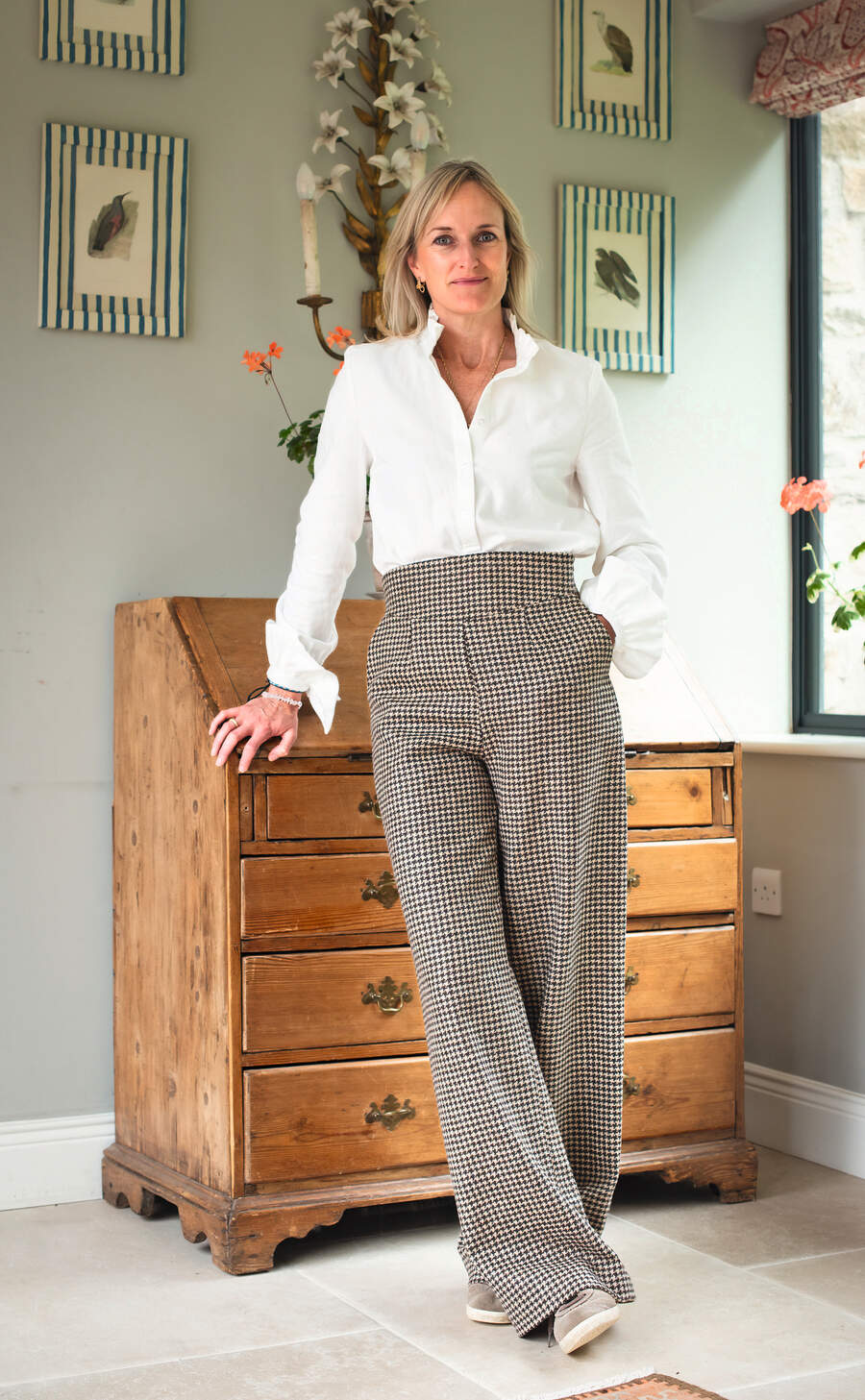
Bella Hoskyns-Abrahall
Bella Hoskyns-Abrahall, Bella Hoskyns Country Clothing
Although Bella Hoskyns-Abrahall grew up in a large family where ponies and outdoor pursuits featured heavily, things stepped up a gear when she started going out with her nowhusband, Bertie. “All of a sudden I found myself going shooting a lot, and one of the things that struck me was how the clothing felt very much like a unisex uniform,” she recalls. “Clothing for women was simply smaller versions of the men’s pieces or they appeared to look very new.”
The first piece of clothing that Hoskyns- Abrahall, who had always loved textiles, designed was a ladies’ gilet. She found a seamstress who could then make it. “This is still the design we use today,” she says. Her desire was to have something practical yet flattering and the gilet received countless compliments: Bella Hoskyns Country Clothing was born. This ethos remains her driving principle today. “My favourite testimonial from a customer was her telling me that her new gilet felt like ‘an instant old friend’,” she reveals.
“For a long time I really struggled to do it alongside my day job and with how I wanted to take it forward but everything shifted when we moved from London to Northumberland, not long after having my third and last baby,” she reveals. “Somehow this big life change brought real clarity and everything seemed to fall into place.
“Not only was there a seamstress who rented a room above the village shop, who could make my samples, but being based in the north of England I was in a traditional heartland of not just fieldsports but also textile manufacturing. Nothing about my business has grown quickly – it has been ‘slow fashion’ in every sense – but the move made all the difference.”
Being immersed in a shooting family, Hoskyns-Abrahall is acutely aware of the functional requirements of sporting pieces, and her husband can frequently be seen putting a prototype for the men’s collection through its paces. “I want everything to look effortless and as if you’ve had it for years: for my clothing to look perfectly at home and stylish but also work, so everything must have sufficiently large pockets, not have tweed that rubs your neck or chin and that sort of thing,” says Hoskyns- Abrahall. “I tend to make my ladies’ pieces slightly longer in length – to cover what I call the ‘danger zone’ – with a rounded edge that flatters the figure.”
The label has what Hoskyns-Abrahall describes as “a very loyal following” – one that includes some well-known names. “We’re lucky in this country with our heritage of high-quality tailoring and textiles, plus having great ambassadors for Britishmade products, such as the Royal Family,” she says. Commercially, however, there is one downside to such well-made clothing. “Because my clothing wears so well, it doesn’t require replacing. Thankfully, many of my customers return for a different colour or a different weight tweed,” reveals Hoskyns-Abrahall. “And I still get excited whenever I’m out and about and see someone wearing one of my pieces.”
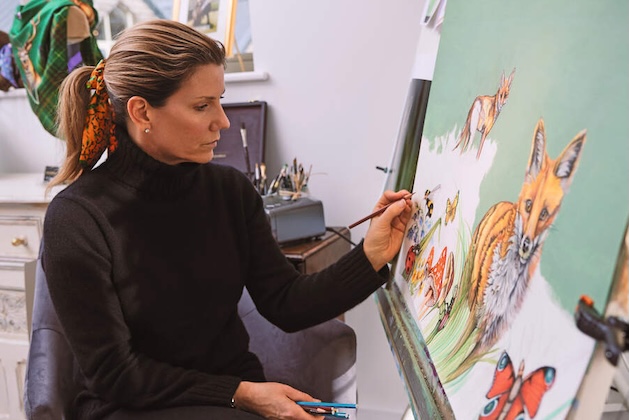
Clare Haggas
Clare Haggas, Clare Haggas Fine Art & Design
A series of dramatic twists and turns have characterised the life and career of artist Clare Haggas: all of which she’s channelled in a positive way. “I was reasonable at art at school but my family were all business people and entrepreneurs, so I was encouraged along that route and duly went to university to study psychology and business. I worked in sales and marketing for 20 years in London. This gave me great commercial experience but, without doubt, the expense account and lifestyle that went with it is one of the reasons I became an alcoholic,” she says.
Haggas has now been sober for 14 years and credits her recovery for kick-starting her new career in art and fashion. “Part of the treatment is finding something that you are passionate about but that isn’t escapism,” she explains. “The beauty of art is you have to sit with yourself, be still and have time to think.” In 2013 she met Will, her now sadly late husband. “He was massively into shooting. In fact, the shoot room at Worlaby, which is down the road from where we lived, was the first place to hang my work,” she says.
“All founders of successful businesses do something they needed themselves but couldn’t find, and that was the same with me. We were doing a great deal of shooting and fishing. I had some lovely clothes, including a cool suit from Really Wild, but there were no scarves I liked. I realised that I could put my art on to silk scarves.”
Although the Clare Haggas range incorporates tailored womenswear, menswear and home accessories, silk scarves are the mainstay – all made entirely in Britain. “What is so remarkable about British manufacturers is the quality and communication; it doesn’t matter whether you order one or 10,000. The fact that sample costs are the same as bulk orders allowed me to build a niche business and also the freedom to experiment and be creative,” she says.
However, this year alone three British silk manufacturers have closed. “Increasingly, I’ve found my time eaten up trying to find new domestic suppliers when really I want to be painting,” Haggas admits. Typically, she still finds the positive. “Despite these challenges [which have included the death of her husband] I look back at where I’ve come from: 14 years ago I was, literally, a heap on the floor. Since then I have opened my own boutique on Cheltenham’s Promenade, have clients in 60 countries from Iceland to Malaysia, and my pieces have appeared in feature films and hit television shows such as The Gentlemen.”
In yet another twist, Haggas announced before this year’s Game Fair that it would be her last. “The business has become so large, plus with the challenges of finding British suppliers, that I’ve been left with no time to do what I love most: painting,” she explains. “So I plan to step away for a bit, focus on myself and my original painting in order to light the fire in my belly again for the next chapter, whatever that may be.” Exciting, that’s for sure.