



This auspicious sporting accomplishment is not only a test of fieldcraft and fortitude but also a celebration of responsible land management
The Field, in association with Westley Richards and Delaney & Sons, challenges you to bag a Macnab between 12 August and 10 November 2026.
THE 2026 MACNAB CHALLENGE
Any sporting sort knows what a challenge it is to undertake a proper Macnab, by which we mean the modern classic iteration, inspired by John Buchan and tweaked for the modern sportsman in the pages of The Field. That is, to catch a salmon on the fly, shoot a stag and finish with a brace of grouse, all taken between dawn and dusk, in one day. It requires skill, planning, dedication and that most elusive sporting element: luck. We are delighted to launch The Field’s Macnab Challenge 2026 in association with Westley Richards and Delaney & Sons, a combination of partners who will not only fit you out with rifle, shotgun and the right kit, but can also whisk you north (or anywhere else, for that matter) in style.
A Macnab is a singular sporting achievement and, for estates that can support such a feat, a badge of honour. It requires an Atlantic salmon caught on the fly, a brace of red grouse and a stag – all taken between dawn and dusk on a single day – to join The Field’s Macnab Club. Based on the cracking yarn John Macnab, written by the sportsman, statesman, historian and author John Buchan in 1925, the challenge is modelled on the self-set tasks attempted by three professionally successful but crushingly bored pals during a dusty London summer.
Charles, Earl of Lamancha, a Cabinet minister; Sir Edward Leithen, a former attorney general; and banker John Palliser- Yates have grown tired of the safety of their accumulated wealth. Individually feeling as though their symptoms of ennui must be corporeal, they seek medical advice on Harley Street. Their doctor, unable to find anything physiologically wrong with his patients, realises that they require an adventure to get them out of their funk. He advises Leithen that to combat his lethargy he should ‘steal a horse in some country where horse thieves are generally hung’.
The trio steam north to the Highlands and, with the help of their youthful warhero chum, laird of Crask estate Archie Roylance, they hatch a plan using the lodge as their headquarters. Under the nom de guerre John Macnab, the triumvirate throws down the gauntlet to the three neighbouring estates, challenging the owners to catch them poaching from their rivers and hills on an appointed day.
Emulating their efforts today is a test of sporting prowess, physical endurance and, perhaps above all, a proper amount of grit. Such attributes must, of course, also be supplemented with a healthy dose of luck. The feather, fin and fur that constitute the Macnab are not susceptible to bribery and care nothing for the depth of the pockets of those who attempt to capture the auspicious prize they represent. Success calls for determination, local expertise and opportunity. A day is rarely long enough, and anyone who is serious about achieving the feat is best advised to block out a full week for the attempt.
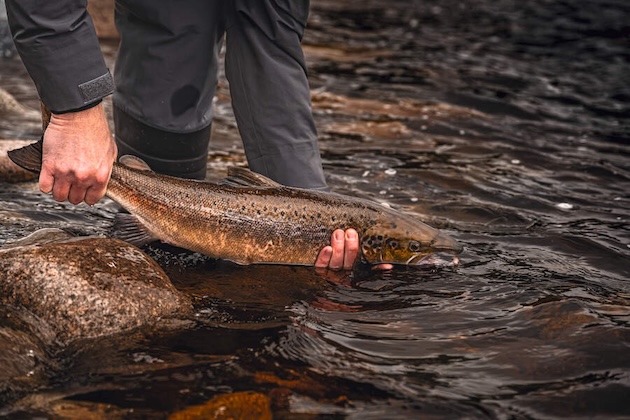
A prospective Macnabber with a pristine fly-caught salmon
Salmon
Selecting an arena for this sporting mission is a complex business. Increasingly the salmon is the least predictable component, so it might be considered an undue risk to book an attempt on an estate with a river that only offers a decent chance of a fish in spate conditions. The Gannochy estate in the Angus Glens, which often accounts for more Macnabs than the rest of Scotland combined, has the ground for all three elements within efficient striking distance. What’s more, the North Esk tumbles through the centre of the estate and consistently delivers fish, launching hopeful Macnabbers on their way. Equally, a smaller ribbon of flowing water can also deliver the goods, as demonstrated last year by the remote Blackwater that winds across the Hebridean wilderness of the Garynahine and Barvas estates.
Grouse and stags
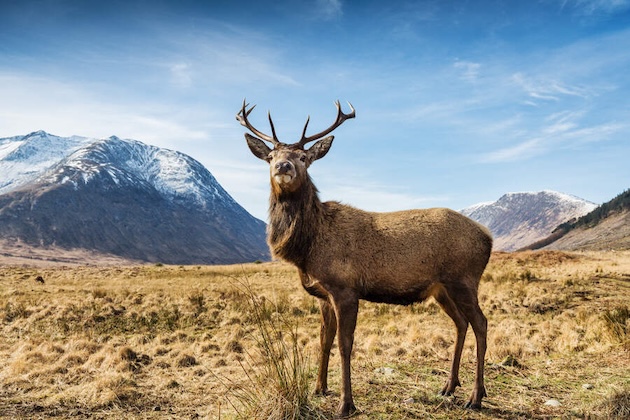
While the grouse are certainly no foregone conclusion either, stags – although plentiful – are perhaps the trickiest of the three. The number of variables is almost endless, and even the most productive estates can be capricious if adverse weather hits. In 2025, the centenary of John Macnab, a bumper number of individuals succeeded in this sporting quest but the year before it was a mere handful. The only way for prospective Macnabbers to give themselves the best chance is to study the form book, keep their ear to the ground and entrust themselves to the grouse keepers, stalkers and gillies who know their craft and beats inside out.
For the estates that offer the opportunity of a Macnab it is a signal to the wider world that they are managing their land responsibly with nature at the forefront.
Producing conditions conducive to the profligation of the Macnab species also benefits the vast majority of other wildlife. The maintenance of healthy moorland in order to support a shootable grouse surplus does wonders for threatened upland birds such as curlew, plover and lapwing; managing deer numbers helps woodland regeneration; while protecting our rivers from run-off and other malign forces creates trickle-down advantages for just about everything else. Estates that can boast a Macnab annually or even a few near misses should be celebrated for their contributions to conservation.
Aside from the thrill of completing the challenge itself, success means joining a special sporting club of like-minded people. Those who submit their evidence and have their Macnabs ratified become members of The Field’s Macnab Club: unlike most, this is not a club for which a friend can propose you or one that has a waiting list. Those who complete a Macnab will be presented with their Macnab silver cufflinks by Field Editor Alexandra Henton at the celebratory dinner in February. We are delighted to thank our generous sponsors, Westley Richards and Delaney & Sons, for their support this year, and look forward to the sporting tales and friendships that the 2026 challenge will bring.
So why not channel your inner poacher and make this year the one that you take to the hill in pursuit of fin, feather and fur? The Macnab is fieldsports at its best and we invite you to join our club.
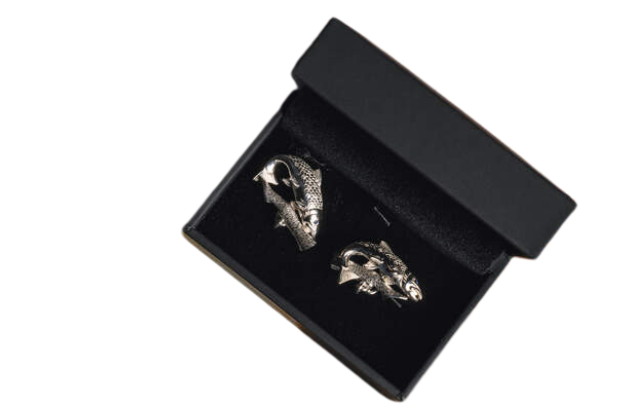
Those who complete a Macnab will be presented with their Macnab silver cufflinks by Field Editor Alexandra Henton
The Field Macnab Challenge
(All fish, if not specified) are to be caught on the fly
Real Macnab
A salmon on the fly and a stag, as the trio did in John Buchan’s John Macnab. They must be ‘poached’ in legal sporting manner from an owner who accepts the challenge.
Classic Macnab
A stag, a salmon on the fly and a brace of grouse. The Classic Macnab epitomises the best of country sports in Scotland and is the sporting test behind The Field’s Macnab Challenge.
Southern Macnab
A couple of snipe, a sea trout on the fly and a roebuck.
Macmarsh
A foreshore goose, a pike on the fly and a fallow buck.
Macnorfolk
A bass on the fly, a brace of wild grey partridges and a fallow buck.
Macscandi
A moose, a capercaillie and a trout on the fly.
Macargentinian
A golden dorado on the fly, 100 brace of doves and a wild pig.
Macafrican
A brace of sandgrouse, an impala and a tigerfish on the fly.
Maccharlie
Riding to foxhounds, harriers and staghounds in a day.
Corinthian Macnab
Riding to hounds in the morning, shooting a brace of partridges in the afternoon and then catching a trout
on the fly in the evening.
Prairie Macnab
A white-tailed deer, a brace of ruffled grouse and a whitefish.
All Macnabs must be completed between dawn and dusk, and within one day. Please note that all fish must be caught on the fly.
To enter the 2026 Field Macnab Challenge, fill in the form here or email field.secretary@futurenet.com

This article was originally published in 2022 and has been updated.
Images. Getty, Sarah Farnsworth