



Intelligent, loyal and striking to boot, the Bavarian mountain hound has one of the best noses in the business when it comes to tracking wounded deer.
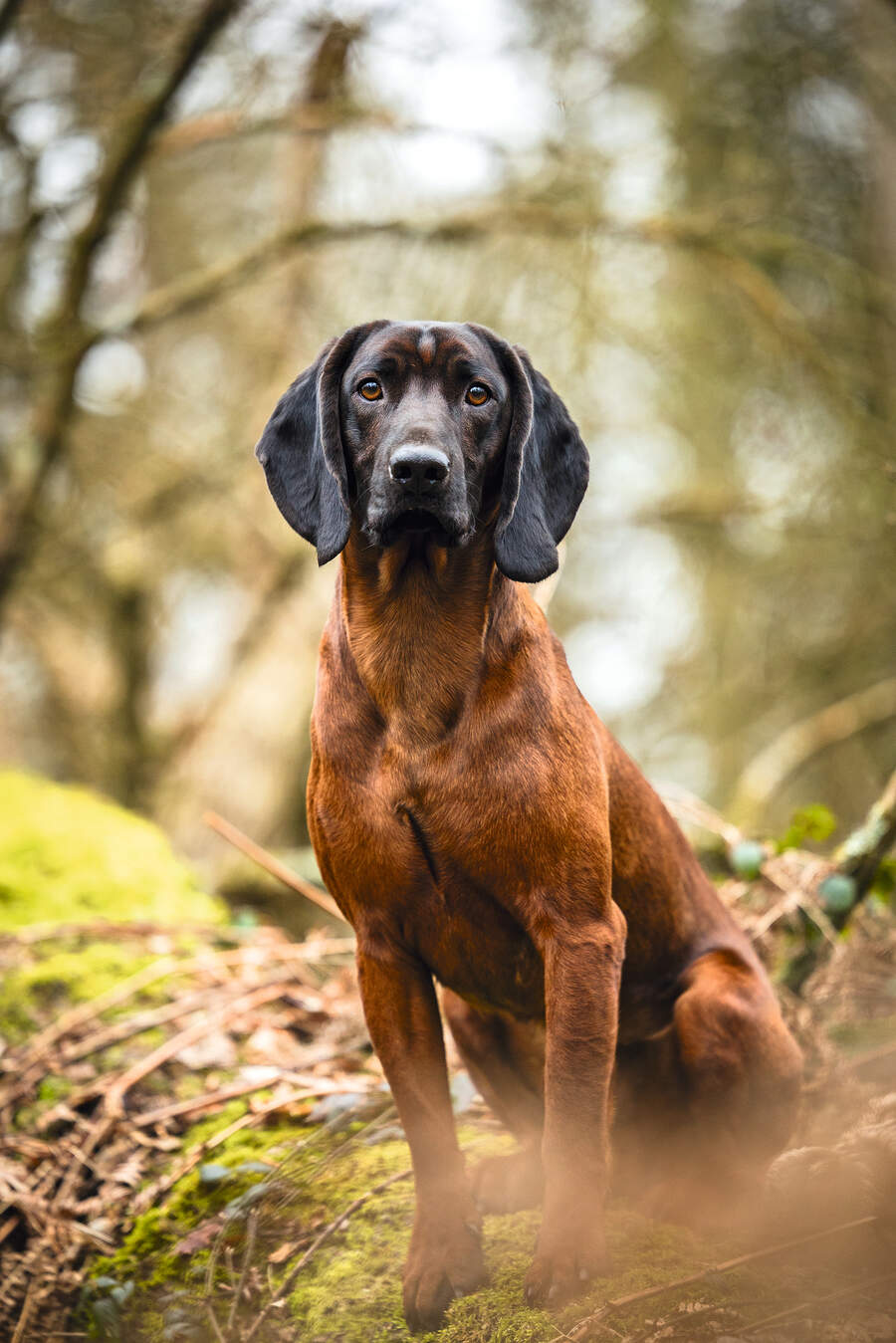
Recalling exactly when you first set eyes on your house, your spouse or even a grouse is to be expected but I am slightly taken aback that I can clearly remember my first sighting of a breed of dog. So beautifully coloured and stunningly glossy was it that I was moved enough to ask what these beasts were. They had the attributes of several types of gundog but not one I could quite put my finger on: a little smaller than a labrador but more athletic; bigger and more solidly square than most spaniels. The colour (deer red with a black mask) seemed to me unique, like a highly polished conker, and I have yet to encounter one with a dull coat.
Bavarian mountain hounds
This ‘meeting’ occurred early in the day at The Game Fair at Blenheim Palace. The pair of dogs were tied up to a pole, sunbathing outside a trade stand. I elicited from their owner that these extraordinary animals were Bavarian mountain hounds (BMH): a medium-sized dog bred to track wounded boar and deer, and bay at them in the mountainous terrain of central Europe. Depending on your definition of a hound (mine would be a dog that follows a scent, speaks when it owns the line and traditionally works in a pack) and of a gundog (one that retrieves game), it seems to me the BMH inhabits the grey hinterland somewhere between the two.
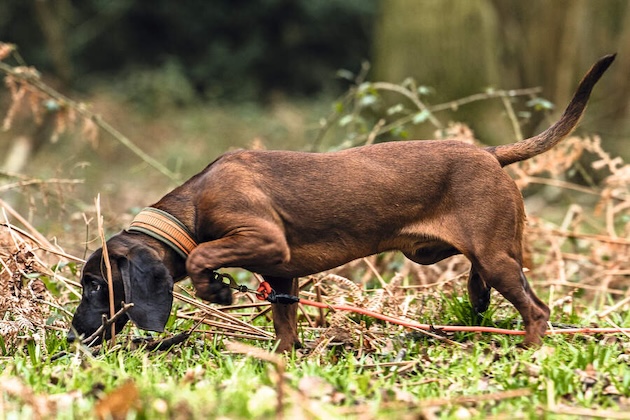
A BMH does not speak until it has found the injured animal, when it circles it and bays until its handler has arrived. Fiercely guarding the quarry until its owner appears is a highly prized attribute. However, more likely than not, these days you will see BMHs individually tracking wounded game on a long, high-vis lead rather than free range. For example, if a fallow deer has just left its imprint on the front of your car and limped off in the dark and you call out UK Deer Track & Recovery (a charity all country folk should have on speed dial) to make sure it is humanely dealt with, there is a half chance that someone with a BMH will arrive in due course to track it.
The breed was developed in the late 19th century
The breed was developed in the late 19th century by crossing the slightly larger Hanover hound and a Bavarian hound, with a bit of Tyrolean thrown in for good measure. The Klub für Bayerische Gebirgsschweißhunde was founded in Munich in 1912. Its aim was a lighter, more agile version of the Hanover hound, better able to work in the mountains and craggy hill country. Although it made its Crufts debut in 2023, in dog years the breed is new enough here for there to be a difference between the working and show types as there is with, say, labradors. The BMH’s stronghold is in Germany, Slovakia, Hungary and Poland, where it is the stalker’s dog of choice.
How many Bavarian mountain hounds?
There are about 1,000 Bavarian mountain hounds in the UK (roughly 90 puppies are registered a year), many are related and their owners mostly know each other. It’s like a niche club.
In Britain deer are shot when static, whereas on the Continent we are talking driven boar so there is a greater margin for error. Of course, even a stationary deer shot in the boiler room might have legs to go 40 or 50 yards and, whether that is a 13-stone red deer in the heather of the Highlands or a muntjac in a thicket of thorn in Berkshire, they can be devilishly hard to locate. Thankfully, the BMH has one hell of a nose and is remarkably intelligent. When a deer is injured, whether shot or hit by a vehicle, a combination of adrenaline and glands between its toes gives off a scent that the BMH can track for up to 48 hours without being distracted by any fresh scent that might have crossed its line. And now with the need to cull the booming deer population appreciated in pretty much all quarters, the breed could start coming into its own.
 Independent streak
 Independent streak
While some people do have them as pets, Bavarian mountain hounds would most definitely not be suited to city life. They need not only exercise but mental stimulation, which is best achieved by a spot of tracking and use of the nose. Without it they can be a handful: in Germany you cannot own one unless you can prove you are an active hunter with access to ground, which those who work them would probably agree is far from being the worst rule ever invented. Eight years ago Colin Roper, a keeper at Farley Hall near Reading in Berkshire who culls 200 deer annually, first saw a BMH tracking a wounded fallow doe in Shropshire and thought he had to have one. His dog Drake, naturally named after a great Englishman, is an outstanding model of a BMH (I suspect Drake knows that) and he is just hitting his stride as a working hound. “There’s a big place for them in the stalking world,” believes Roper. “Thermal imaging has removed some of the art from it but this dog can always help them out. BMHs struggle in a kennel, though; they need mental stimulation. I call them ‘cat-dogs’: they have an independent streak.”
So sensitive and specific are their noses that their breeders will start tracking 20 yards at 12 weeks old with them and that is extended as the puppy develops. “You let them do the work, you don’t encourage them,” says Roper. “With a young dog you might do 200 metres alongside a hedge to give it a barrier on one side. Being vocal on the bay is extremely important, especially if they are off the lead.”
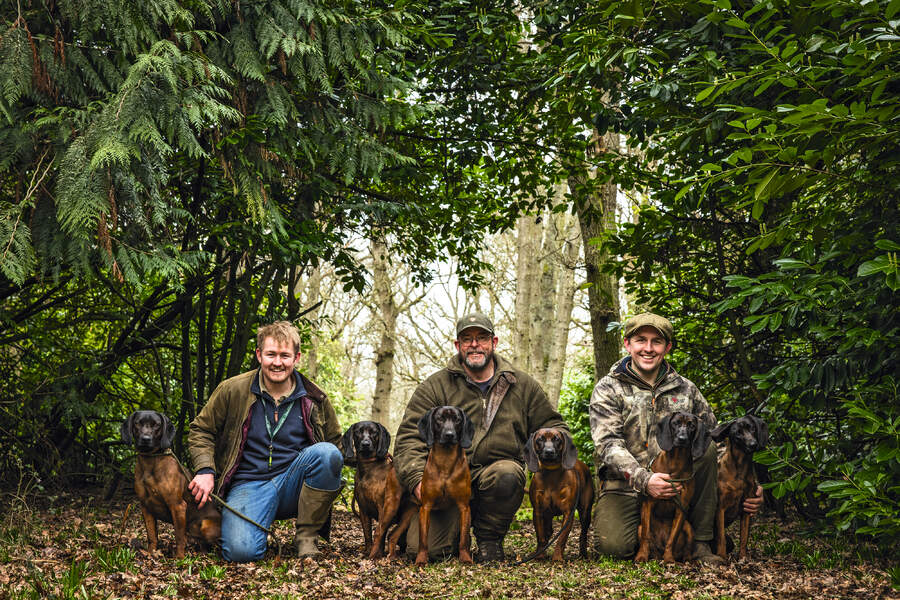
Josh Ballance, a farm adviser in the Peak District, is a medium-sized cheese in the Bavarian Mountain Hound Society of Great Britain. This was founded in 2007, is Royal Kennel Club registered and has the goal of keeping the working lines going. He too was at our BMH ‘mini meet’ at Farley Hall with his working dogs: Ludo and his sister Winnie. Also in attendance was Jack Lawrence, a keeper in Oxfordshire, who brought Xena and her mother Sika. Our photographer, Anya Campbell, completed the party with her not-so-working puppy, Gretel. A recently shot muntjac made a cameo appearance as the trail, and everyone passed the test with flying colours.
To bring some fresh blood into what is essentially a very small pool here, Ballance artificially inseminated his bitch with fresh semen flown into Luton from Anna Majdacka in Poland: the world authority on the breed. “I drove it to Shropshire, had a vet inseminate the bitch and we had a litter of 11,” he recalls. Ballance and Lawrence manned the BMH stand in the Discover Dogs area at Crufts and, this spring, a similar display at The Stalking Show. “It’s been successful in terms of breed health and awareness but people see them, think they’re gorgeous and decide they want one. We’re not warning people off them but we are trying to get the message across that they are working hounds rather than pets,” underlines Ballance.
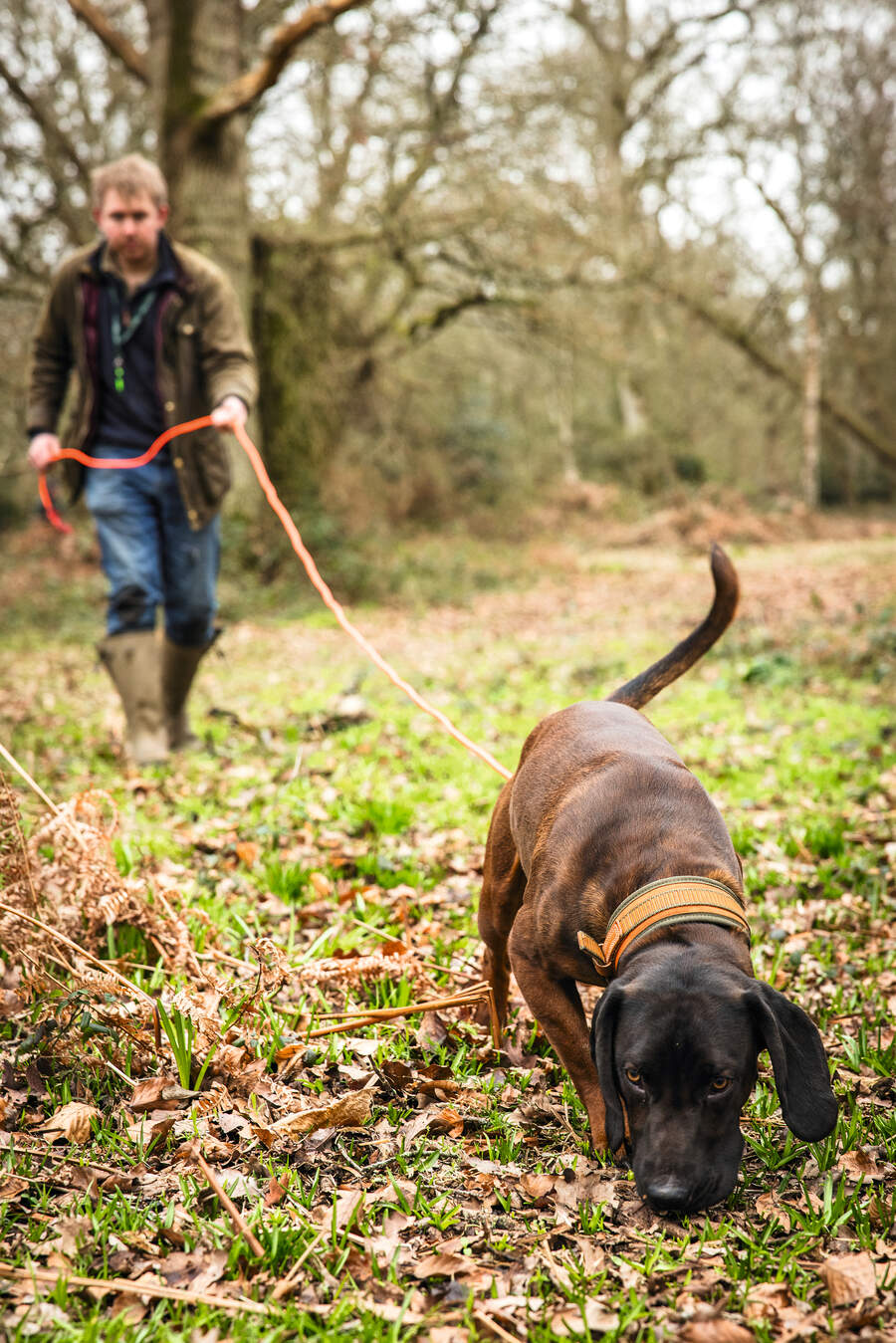
Bavarian mountain hounds need plenty of exercise and mental stimulation
“The only time Ludo clocks out is after a couple of hours of work with his nose. If I’m away for a day I’ll lay a 500-metre trail for him the day before, leave it a minimum of four or five hours and up to 24 hours before going back with him on a long tracking lead. I just follow the dog,” he continues. Gretel’s work is less traditional; she is a photographer’s assistant but gets plenty of exercise. “I think they’re great pets but I can understand why people who work with them would disagree and why they’re trying to prevent people who live in cities from having them,” says Campbell.
“They are so loving and loyal. All the people I know who’ve had one want another because they are immensely intelligent, biddable and amusing. However, you need to be really strict for the first 18 months,” Campbell warns. “After that you have yourself a really nice dog. They need at least a couple of hours’ exercise each day. When I lived on a farm in Devon, going to the stables to get horses in and doing the daily chores all added up, so I didn’t need to do a two-hour non-stop march. If you take them for a shorter spell, it’s important they get a lot of running in it. Gretel sits under my desk for hours but when she goes for a walk she needs to be a hound and sniff.”
Designed to run
This isn’t Campbell’s first BMH: “When I took my last one fishing she’d sit and watch every single cast. On the coast she’d look in every rock pool and be fascinated if we caught something,” she recalls. “They’re a bit like cats: if you give them something you’ve caught, they’ll skip around it, throw it in the air a few times and then eat it. You can see from their physique that these dogs are designed to run but then Gretel can also be really calm afterwards.”
Like all her fellow owners, Campbell finds going anywhere with her BMH can be a drawn-out process, despite their athletic prowess. “Everyone stops me wherever I go because they haven’t seen them before and are curious to find out what breed she is. Then they’re totally charmed. The BMH is a magnet for people, not a dog for the antisocial,” she insists. “I think if I had a spaniel, the breed I grew up with, or a labrador now it would feel very boring. BMHs are quirky and maybe even too clever; they can be spiteful. If they don’t like what you’ve told them they might go and pee on your bed. I believe they are capable of doing things they know are naughty.”
Close to my Lambourn home is Katinka, a BMH owned by the Earl of Harrington. “I first clocked the breed when shooting boar in Germany. They were phenomenal,” he says. “A lot of Katinka’s litter were sent to South Africa to track poachers.” She is, according to his wife Anita, a special dog: “The demonstrative affection is on a scale I’ve never seen in another breed; she’s as smart as a bag of monkeys. BMHs have short coats and virtually don’t moult, so she’s very welcome on our bed.”
The BMH is bright, intelligent and loyal. And, as a stalker’s practical companion, in a field of its own. Whether one chooses to give it a bed of its own, well, this writer leaves that to your discretion.
Photography by Anya Campbell.
For more guides and country-related articles, subscribe to The Field Guide To monthly newsletters and receive a complimentary guide to dogs from Country Life magazine.