



Specified by Sportarm and handmade by Grulla Armas in Spain, this fine pair of sidelock ejectors boasts near-London quality at a more accessible price, says Michael Yardley
HJ Hussey Imperial side-by-sides

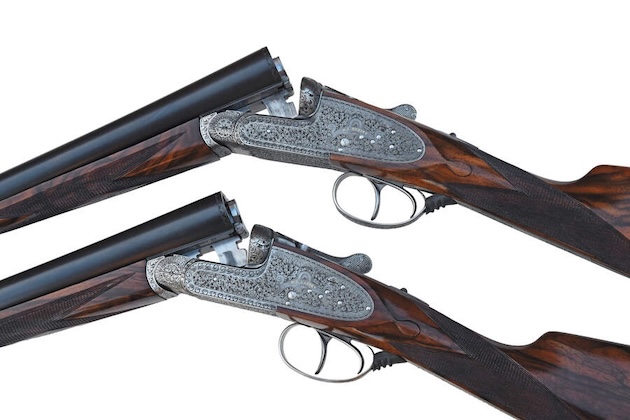
This month our test considers a pair of 29in-barrelled HJ Hussey Imperial sidelock ejectors built by Grulla Armas, the respected and long-established Spanish maker. They have been produced for and specified by Sportarm, a firm located both in Dorchester and at the West London Shooting School (where the test guns reside) and that has long experience importing and developing Spanish guns for British game shooting. These Grulla Husseys follow a pattern similar to a Holland Royal or AyA No 1. They weigh 6lb 15.5oz and 6lb 15.2oz – midweight but comparable to vintage Royals circa 1900 – and balance on their hinge pins. The guns are (unusually) 3in chambered and Spanish proofed for high-performance steel. Marketed as top of the range, they are priced at £57,360. This is a capital sum but best London guns now begin at about three times that per gun. The Grullas are built in much the same manner, on the bench by traditional methods. They might not be quite as finely finished but it would take an expert eye to notice significant differences.
First impressions
First impressions here are of handmade quality, excellent wood and tasteful handcut engraving and chequering. The Hussey house deep scroll is particularly attractive (Sportarm acquired the name of the old English firm in 2008). I favour scrollwork on a game gun rather than game scenes unless they are of real artistic merit, which may add substantially to cost. This pair boast beaded edges to their square-bar actions too, and to the right side of the trigger-guards. There are eight pins to the sidelocks and cocking indicators, which are neatly done with engraved arrows. A banner with the Hussey name in gold appears above. Engraving to the action belly and trigger-guard bow also pleases. The guns look good. It would be a challenge to improve the aesthetics much.
The chopper-lump barrels are bored at 18.6mm and include relatively short forcing cones: about 25mm, suited to felt or fibre wads as well as plastic. They are well struck up, showing a minimum wall thickness of 31 thou, and fitted with concave ribs. Chokes are ½ and ⅜ so suitable for steel or lead. The barrels also carry a Holland-style assisted opening mechanism beneath the foreend, as patented in 1922 by Henry Holland and William Mansfield. It incorporates a coil-spring-powered plunger. When the top-lever is pushed to unbolt the barrels, this mechanism forces the action open, facilitating faster reloading, whether the gun has been fired or not. By contrast, the Purdey system uses the top limb of its mainsprings to power the self-opening feature.
Sportarm has done an impressive job in specifying these guns. It has significant experience as noted, having sold 40-plus Grullas as well as many AyAs made to its house requirements. A number of British companies now put their own name or older ones that they have acquired to Spanish guns commissioned in imitation of London best. Is this trend positive? If the guns are taking form and aesthetics from the great makers, there is general benefit. New guns built with English trade and shooting-school input may be better suited to the British driven shooting market than might be produced by foreign firms alone. Prices remain more accessible too. It seems a sensible evolution in a niche market where demand for classic side-by-sides suited to modern loads probably outstrips British manufacturers’ ability to supply them economically.
If the end result is more shots enjoying practical, visually pleasing guns inspired by the old makers, and traditional craftsmen in places such as Eibar keep their jobs, it’s hard to see it as anything but positive. The key is transparency: as long as buyers know exactly what they are getting – Spanish handmade to British specification, not ‘made in London’. These guns are developing their own cachet.
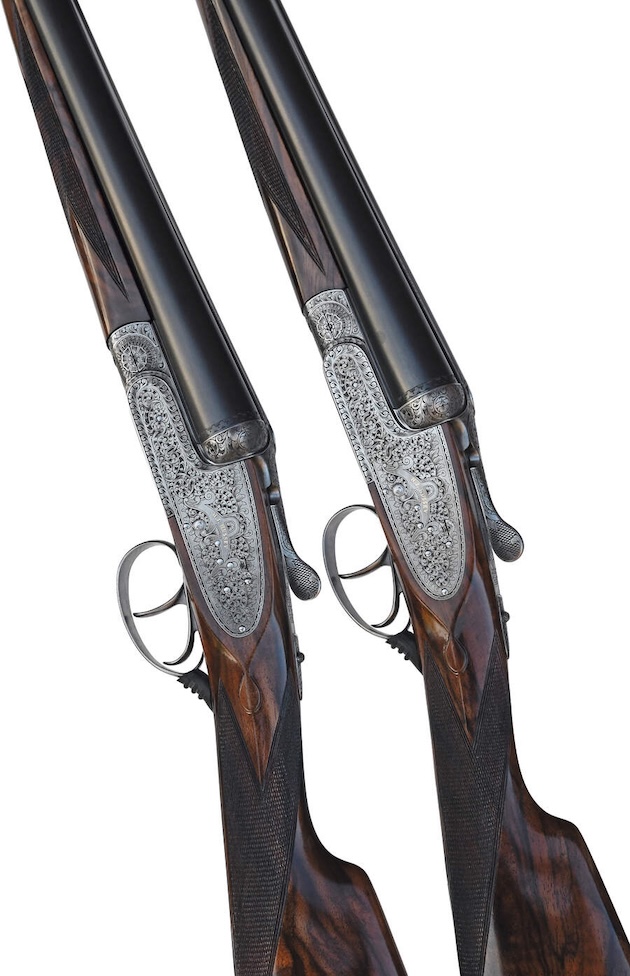
It would be a challenge to improve their aesthetics much
Technical
The action of the test guns is mechanically almost identical (save for some tiny additional locking screws) to a later-model Holland Royal. This bar-action sidelock was originally presented as a flagship model in 1885, though the name appeared before. Early guns had leg-of-mutton locks rather than the more modern shape first seen in Frederick Beesley’s seminal sidelock design of 1880 (soon after licensed to Purdey). Holland copied this stylish look circa 1894, and its mechanically well-sorted Royal took on its modern, much-imitated form. The bar action employed V mainsprings and Southgate ejector work based on an over-centre cam principle. Assisted opening came in 1922. The Holland design, a fusion of all things good in regard to side-by-side development, was adopted by AyA and other foreign makers, including Grulla and Arrieta. It is an extremely reliable mechanism, much rated by practical gunsmiths. Grulla has been making it in square- and round-bar form for decades.
Shooting impressions
I shot the guns at West London Shooting School. The 29in, hinge-pin-balanced Husseys had few handling vices. Classically profiled stocks and sensible shelf measurements (length of pull 14⅞in, drop 1½in and 2in with ¼in cast at heel) helped. Grulla’s products are bespoke, so you can have any dimensions you desire and any stock style but these elegant traditional shapes, long proven, work. Stock form is as important as fit. Some makers don’t manage to get the details of comb and grip right. Not here. The Husseys feel secure in the hands with Holland-style ridged grips and good but slim combs. They point and control recoil well. Triggers all broke around 3lb. The guns were intuitive in use. One didn’t have to work hard. The overall weight just under 7lb was right. Concave sighting ribs are well done but, reaching for perfection, flat ribs and 30in tubes might be specified. Excellent guns, though.
Grulla Armas HJ Hussey Imperial side-by-sides