




Featuring upgraded wood and tasteful scrollwork, Beretta’s A400L semi-automatic combines good looks with excellent all-round performance, says Michael Yardley
Beretta A400L semi-automatic

I have been looking at the latest, scroll-engraved version of the Beretta A400 semi-automatic: the A400L. The gun is 3in chambered for high-performance steel (as well as standard loads), and attractively stocked in what Beretta calls ‘Grade 2.5’ walnut. It weighs in at 7.8lb – midweight for a repeater – and was supplied by GMK of Fareham.
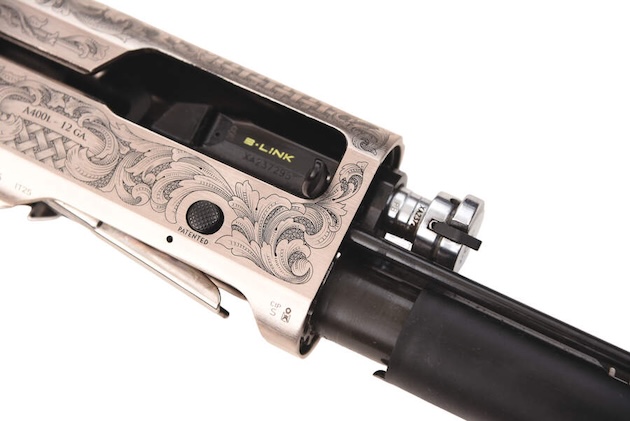
The A400L under test is distinguished by its silver coin finish and enhanced action decoration. Semi-autos are not usually so adorned but this scheme pleases the eye without looking overdone. I tend to prefer plain repeaters but the A400L scrollwork, applied by laser, looks tasteful. The other detailing is good too. I liked the slim, blued-steel trigger-blade and finger-friendly (reversible) cross-bolt safety in front of it. The bolt release catch (also blued steel) contrasted nicely with the action but could have protruded a little more for ease of use. A well-sized alloy fore-end nut facilitated fast, fumble-free assembly and disassembly (a characteristic of the 400 series).
Additional features of the test gun include the well-proven and fast-cycling B-Link rotary bolt operating mechanism and a hammer-forged Steelium Plus 30in barrel with 14in forcing cone and extended Optima HP chokes. The sighting rib is ventilated and slightly tapered (10mm to 8mm) with twin beads. There is an alloy-framed trigger group, stainless-steel loading carrier, an ambidextrous pistol grip and Microcore polymer recoil pad as well. The A400 also boasts a useful facility for stock height and cast adjustment by means of replaceable shims placed between the receiver back and stock head.
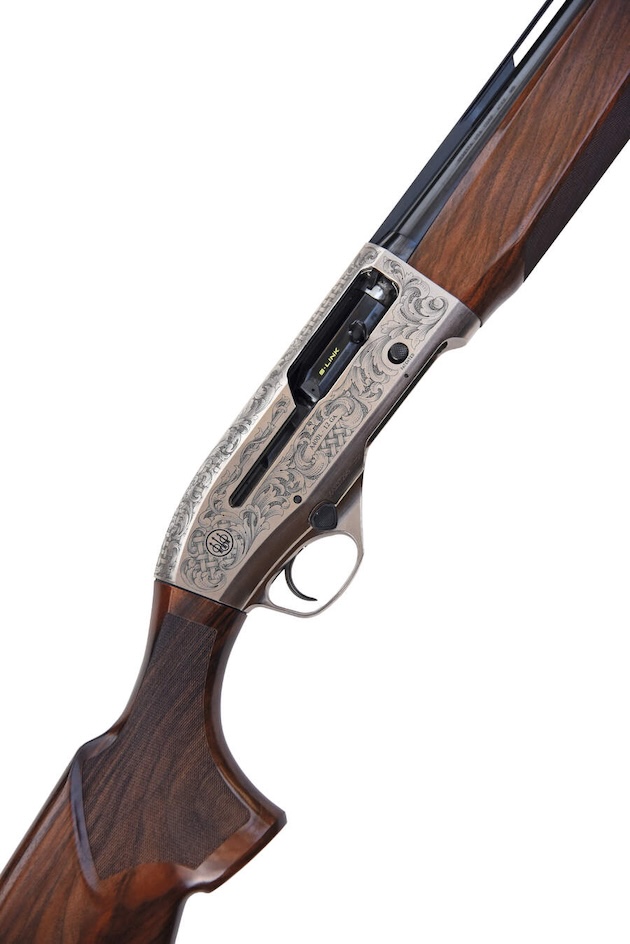
The silver coin finish and enhanced action decoration please
Beretta launched the A400 in 2008. Its history takes in both the development of the rotating bolt (one of the distinguishing features of the A400 design) and the evolution of the modern semi-automatic shotgun more generally. Let us explore the bolt first. Beretta had experimented with a rotating bolt head – useful because it handles high pressures well – in its 1931 and 1937 recoil-operated military rifles. It was not a new idea. Remarkably, 40 years before in 1891 Colonel George Fosbery of Webley-Fosbery and Paradox fame patented a 16-bore, slide-action, magazine- fed shotgun with a rotating bolt-head (one example is known to exist). Rotating bolts became the norm in later military weapons such as the gas-operated AK-47 and Armalite.
The rotating-bolt concept took far longer to perfect and popularise in shotguns. It was seen in the Benelli Montefeltro of 1983 and M1 Super 90 of 1986, both combined with inertia actions. Beretta acquired Benelli in 1983. In 2002 it brought out the 3½in magnum-chambered gas-operated AL391 Xtrema with a rotating bolt-head similar to that in the A400s now. This probably took inspiration from the Benellis mentioned, although the new Beretta was gas-operated as noted – the system the firm has always favoured.
Beretta had mastered gas operation in its alloy-actioned 300 series, marketed from 1968 (though its first gas-operated shotgun was the model M60 of 1956). It has pursued this system in semi-autos ever since (save for the extraordinary short-recoil UGB25). Remington’s 1100 of 1963 was another influential gas-operated design (although the JC Higgins Model 60 of 1956, Remington 58 and 878, based upon it, predate the 1100). The Beretta 300 remains one of the finest semi-autos ever made. Notable for its alloy receiver and simple, reliable mechanism involving a bolt with a ‘rat’s tail’ extending into a butt-located spring tube, it is fast handling and soft in recoil.
Some subsequent Berettas have necessarily become more complex to handle a wider cartridge range (including 3½in ‘Super Magnums’). These later designs, such as the Xtrema and 400 series, employ a rotating bolt, improved valve mechanisms and use double cocking bars with a return spring efficiently positioned over the magazine tube instead of rearwards.
Technical
The test gun is a rotary-bolt, gas-operated repeater that bleeds off gas from the barrel via two vent holes to operate the mechanism. Gas operation typically offers less felt recoil, sometimes at the cost of greater mechanical complexity and increased cleaning. In the A400, though, an improved piston is incorporated in the gas mechanism. It has teeth on a sprung steel circlip and needs less cleaning than older types. During cycling the operating piston moves back and forth in the under-barrel housing, with the internal scraper removing fouling. At the rear, twin steel cocking bars are welded to a slider partially covered by a polymer tube (intended as a guide and debris shield) that also houses a return spring encircling the aluminium magazine tube. There is no rat’s tail attached to the rear of the working parts as seen in the 300s/390 and 391. The bolt is driven rearward by the gas piston and forward by the return spring: a clever system.
Shooting impressions
Being a fan of semi-autos, I was keen to shoot the A400L. It felt substantial, though overall weight at 7.8lb was not excessive. The ambidextrous palmswell grip was large and might benefit from slight slimming. The fore-end was quite deep rearwards. Missing a couple of skeet birds initially, I shifted my attention to sporting targets. These were shot with the A400L and my old 30in 7.4lb Beretta 303 for comparison. Results were, surprisingly, identical. Nothing was missed over the first 20 birds with either gun. I had not liked the A400L as much as my 303 at first; one is more aware of the mechanism working than with the simpler 303. However, this A400L proved to be an excellent all-rounder – soft recoiling and intuitive. It is particularly attractive for a semi-auto, well made and not unreasonably priced when enhanced wood and engraving are factored in.
Read our gun reviews every month with a subscription to The Field magazine.