




Older guns, such as this circa 1900 sidelock ejector, can offer character and quality at an accessible price. However, it is vital to look beyond the superficial, says Michael Yardley
Chamberlain vintage side-by-side

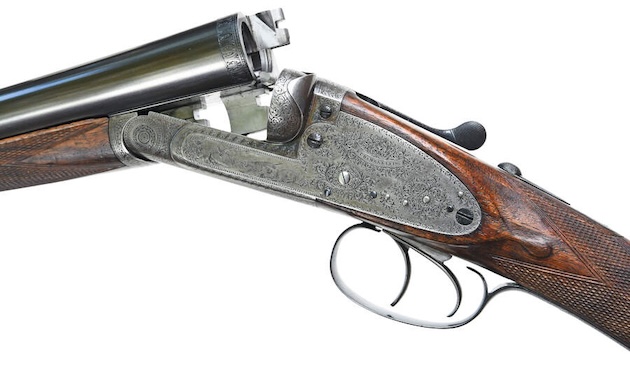
This test gun is not our usual fare, being an intriguing Edwin Chamberlain back-action, seven-pin sidelock ejector side-by-side made circa 1900 (somewhere between 1896 and 1904 from the proof marks). It comes to these pages courtesy of veteran dealer Victor Chapman of Marks Tey, Essex. The featured gun has 30in barrels; a flat, tapered, file-cut rib; and a straight-hand stock with double triggers. A weight of 7lb 3oz suggests it may have been intended for pigeon shooting (especially when considered with its wide rib of typical late Victorian or Edwardian pigeon-gun type).
It is a good-quality and attractively decorated gun but not ‘best London’. The distinctive engraving – fine scroll with seminaive Victorian-style game scenes – shows pheasants being walked-up over pointers (which could also suggest a heavy game gun). To complicate matters of provenance, the top-lever of the test gun is engraved with a ‘1’ but the barrels with a ‘3’. This might indicate a gun made with three sets of barrels (unlikely) or that a set of barrels from the third gun of a trio has been fitted to the action of this one (unusual but not impossible). The mystery remains unsolved but the barrels fit perfectly and show signs of fairly recent re-jointing.
This gun bears some of its original Birmingham proof marks, and London reproof marks (2015) for 2¾ (70mm) cartridges. Old ‘13’ marks on the flats of the dovetail-construction barrels reveal it was originally made as a 13-bore (.710in) – again suggesting a pigeon gun – with 12-bore chambers. Standard 12-bores traditionally measure .729in but 13/1 guns are also often seen (.719in); occasionally 12/1 may be encountered, which equates to .740in. It has been bored out significantly at some stage, probably to remove pitting, and reproofed. The bores now measure .723in and .724in. Barrel walls both show 24 thou minimum thickness, which reassures. There is still some allowance for accidental damage.
When buying a vintage gun it is vital to get some expert help. Specialist equipment (bore micrometer and wall thickness gauge) is required to check proof and barrel condition. Tap the carefully suspended barrels to see if the rib is loose (they should ring not rattle). Action jointing needs inspecting: the action body and stock must be minutely examined for cracks. Replacing a stock or barrels is no longer cost effective in many cases, as artisan work is prohibitively expensive. Buying older guns, like buying older cars, is fraught with hazard. Vintage side-by-sides can be exceptional value in the present, challenged market – bargains are many – but condition is everything. This restored gun is being marketed quite optimistically at £3,500.
There is, meanwhile, no point in buying a superficially pretty old gun if you must pay several times its cost to put it into working order. Be careful. Consider the cost of work. The specific issue of steel shot also needs to be considered. Our test gun appears to have had much of its choke removed. Once this would have knocked its value; however, its present, evidently modified constriction, 2 and 4 thou, would be theoretically fine for standard steel shot – although I am still hesitant to use it in vintage guns.
Dating this gun precisely has proven a challenge too (its serial number is 2098 if anyone still possesses the relevant records). We know Edwin Chamberlain operated from premises first at Winchester Street then at Bridge Street in Andover until 1901. It also operated later at Wote Street, Basingstoke circa 1913-22. The Andover shop remained open until 1940. As for this gun’s date, the style of engraving suggests 1880s or 1890s, the proof marks a little later. The elaborate fences look vintage too, not to mention the under-bolted toprib extension. While the sidelock aesthetics don’t look fully evolved, it’s an attractive and interesting gun nevertheless.
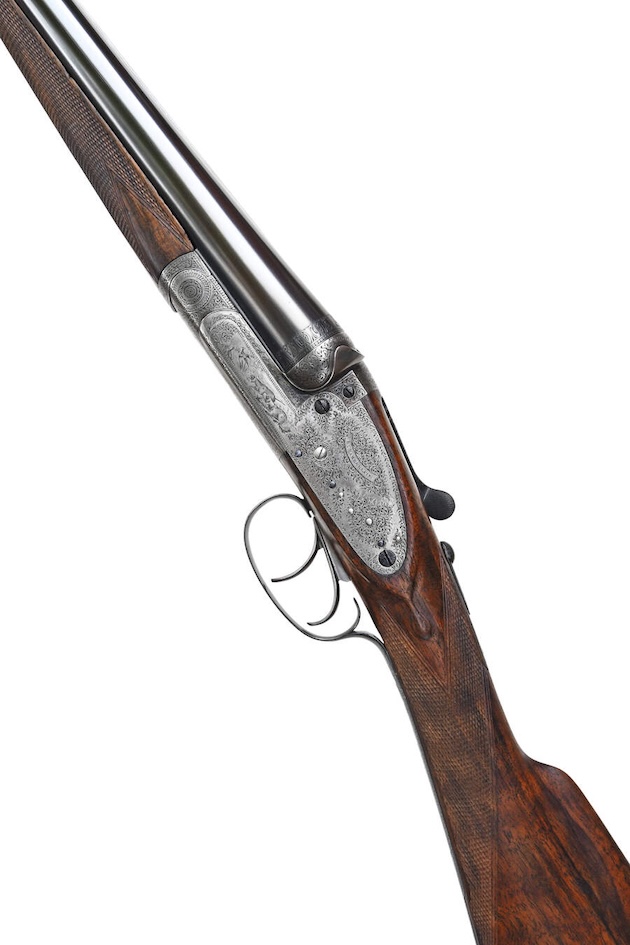
While not ‘London best’, the gun has some quality features – especially in regard to finish
Technical
While this is not a best gun, it has some quality features – especially in regard to its finish. But why is it not a best gun? It is a back-action sidelock rather than a bar action. In the former the mainspring is positioned behind the hammer; in the latter the mainspring is positioned forward, protruding into the main body of the action bar. The back action is a particularly strong design because less material is removed from the action. Also, the gun is not ‘stocked to the fences’ but has the front barrel lump protruding through the bottom of the action. The barrels themselves are built on the dovetail system, which although seen in some best guns is not typical of them. The gun is an improved, relatively streamlined sidelock ejector (as perfected in the 1880s and 1890s) and also incorporates an unusual under-bolted ‘third bite’.
Shooting impressions
I liked the form and handling of the Chamberlain: good weight and balance (about 1in forward of the cross pin), 30in barrels and an excellent, flat, file-cut rib. But first impressions are not everything: intrinsic quality, mechanical condition and actual performance must be considered. This gun was a bit low in the comb, although not enough to warrant a comb raiser for testing. Simple crossers broke well with Lyalvale 24g 71/2s and kept on breaking as range extended. A lack of choke was no significant issue. The relatively weighty barrels always felt steady. Felt recoil was modest. The rear trigger had a little creep. I had one misfire. No serious vice was detected but an action service would be prudent. Nevertheless, the Chamberlain passed the practical test. It was in serviceable condition without needing much further outlay and could be shot confidently. This endearing old gun (and others similar) can offer character and quality at attainable cost. However, caveat emptor: condition is everything.