

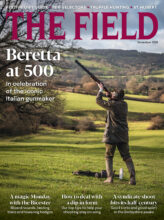


The artist, writer and countryman sits down with Mary Skipwith to discuss painting, pigeon shooting, conservation and his profound connection with the natural world

Unsurprisingly for someone who has spent most of his life gripping a paintbrush, pen or gun, it’s with a firm handshake that William Garfit greets me on the doorstep to his studio: a treasure trove befitting such an artist and countryman. Paintings of rivers, coastlines and flowers adorn the walls while an easel bears a sweet pea so realistic the person it was painted for believed it to be pressed. Cartridge belts and snares garland beams that rods lean against. “I have devoted my time to things I am keen on, whether it’s in shooting, writing, fishing or tree work,” Garfit remarks. “I’m aware there’ll be a watershed of accuracy with my skills; as one ages, the graph of experience goes up while dexterity and reactions take a downward turn. But I still get up looking forward to what I’m going to do every day.”
On completing studies at Cambridge School of Art, the Byam Shaw and then a postgraduate at the Royal Academy Schools, Garfit showed such aptitude in portrait painting that he was nominated for membership of the Royal Society of Portrait Painters at just 23: “As a country boy I wanted to be outside painting, so I turned it down despite worrying it was commercial suicide.” There’s nothing like the Tryon Gallery exhibiting his work since 1979 to allay such fears.
His reputation was further built by working for Shooting Times as an illustrator. Garfit says it not only developed his drawing skills but led to some 30 books containing his illustrations. Alongside these on his shelves sit the four books he penned on shooting. “I don’t consider myself a writer but found I could write in a way that resonated with all sectors of the shooting world. I think my articles were similarly accessible,” he says. For 27 years he wrote a column for Shooting Gazette, conceived after the editor rang him short of copy. “I answered his questions and he typed it up,” he recalls.
Shooting pigeon
Despite decades of writing about shooting pigeon and the achievement of averaging 100 pigeon a day for 1,000 days over 19 years, Garfit’s passion hasn’t waned. “As I get older the joy is in the quality of the day. If I’ve got the fieldcraft right I am optimising what I can do, so whether the bag is 20 or 200 is immaterial. You can only be effective if you’ve done your reconnaissance. The pigeon is truly wild and can fly as high, fast and jinky as any other bird. It’s a sport of the loner: that’s what I like about it. Painting is similar.”
To capture the essence of the landscape most truthfully, Garfit paints on location. “The sky shows what’s happening in terms of the light and mood. That’s then expressed in the horizon, and the relationship between the two tells you the atmosphere. I work on the background and horizon, into the sky and then through the landscape, almost walking out of it to the foreground. It establishes space and distance,” he explains. “I used to paint entirely true forms until I realised Constable moved things around. If it’s a river I like to be correct – relocating rocks doesn’t reflect the angler’s reality – whereas shifting a tree to see more of the landscape can improve a painting.”
Garfit’s artistic vision helped when, keen to fulfil his ambition to have some land to manage for wildlife, he bought disused gravel pits near to his birthplace at Hauxton in 1970. “I used the pencil I had been drawing the life model with in the morning to bid on 69 acres in the afternoon. That was the start of my dream,” he says. Over five decades, he converted the area by managing the woodland, building lakes, developing fisheries and establishing a shoot as well as a tree business. Winning the Laurent-Perrier Wild Game and Conservation Award in 1988 was one of his proudest moments, although personal memories are equally as cherished: “One of the lakes was where my son learnt to swim and row, where he shot his first duck and goose, and where he bagged pheasants and pigeon. That corner of England means so much to us because of those experiences.”
Musing over his connection to the countryside, Garfit reveals: “My sense of religion is that I can commune with God outside, where we are in His world together. There is something beautiful in every day. I call it my organic orgasmic moment – when the light touches a bramble, a butterfly. It’s all there to be noticed but few people are privileged to have that window unlocked.” He has striven to pass that key to the next generations, taking them birdwatching and going away with just one child or grandchild. “It’s a privilege to have time with them to allow proper focus and conversations. I fear the tide coming in on a number of our sports but the fundamentals of nature will remain: fieldfares in a hedgerow, waders on a beach. There will always be another element of beauty to enjoy, if only you have the eyes to do so.”
Such power of observation in the outdoors has undoubtedly contributed to Garfit’s enduring success and pleasure: “Hauxton’s habitat management, the shooting world, the painting world of landscapes and rivers, the writing world – they all link to the ground I stand on and hold dear as a countryman.” One thing is certain: he intends to wring out every drop of joy by grasping life with both talented hands.