




Holland & Holland’s latest handcrafted big-game rifle represents a striking synthesis of tradition and modern engineering but you’ll need deep pockets, says Michael Yardley
Holland & Holland Takedown Magazine Rifle

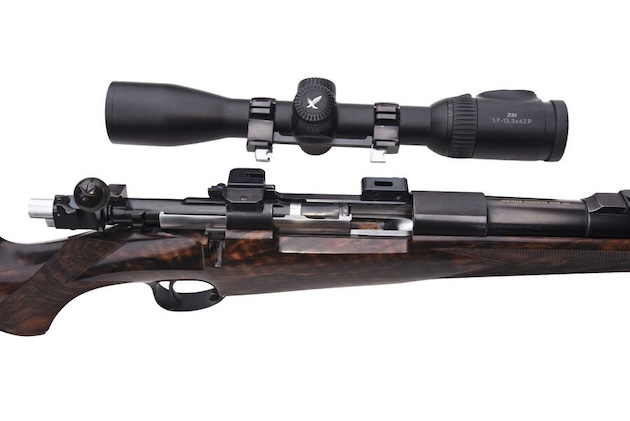
The spotlight is on the new Holland & Holland (H&H) Takedown Magazine Rifle in .375 H&H belted magnum – still one of the most versatile and applauded big-game cartridges ever to be developed. The .300 H&H (based on the same case) is another interesting, and famously accurate, option for the model, with many others available. This elegant and innovative gun is built on a long, square-bridge, Mauser 98-style action. It is set in a machined carbon fibre chassis bonded into a classically proportioned, best London-finished walnut stock. There is a full pistol grip of subtle Holland diamond form, a classic English beaded-edge pancake cheekpiece and a leather-covered pad. It looks like a traditional London best rifle but the chassis system dispenses with the recoil bar typically seen in magnums, enhancing material stability (and accuracy) in all atmospheric conditions. In engineering principle, it is reminiscent of a modern military sniper rifle but retains classical and exceptionally clean looks externally.
H&H’s simple but effective takedown system – where barrel and action remain connected – allows the barrelled action to be removed from the stock by means of a single, wide-slotted screw and reassembled, still maintaining zero. A redesigned single-stage titanium trigger unit benefits from a vapour-blast finish to enhance function and reduce wear. The FZH action, machined from billet, is sourced from Germany (as, indeed, original Mausers were by British makers for their best bolt rifles). H&H has PVD (physical vapour deposition) coated the bolt, which has a swept form to easily clear a scope and speed cycling. ‘Knurling’ to the well-sized bolt knob is hand engraved. The gun also boasts Holland-system quick detachable mounts (PVD coated too), in this case carrying a Swarovski Z6i 1.7- 10×42 30mm tube scope – ideal glass for European woods or African veldt.
This sophisticated rifle, which weighs in at a substantial 9.72lb without scope (and 11.18lb with), is available in ‘Best’ (as tested), ‘Deluxe’ and ‘Exhibition’ grades in various action lengths and calibres. Its form is elegantly tapered in classic house style with a capped full-pistol grip (incorporating a border-engraved, hinged cap-box containing a spare foresight) and a relatively slim fore-stock with ebony end. The well-radiused grip includes a subtle but efficient Holland diamond central ridge. Moreover, the grip’s cap box is colour case hardened and houses a spare front sight as noted. There are folding leaf sights on a quarter rib too, and a spearpoint front sight with folding hood and moonsight for poor light sans scope. A three-position wing safety is fitted with lettering in gold. The muzzle is screw cut with a thread protector.
On mounting, the H&H rifle feels exceptionally well balanced with its 24in barrel (other lengths are available). You would guess it was a pound lighter than the stated weight. Grip, fore-end and head position relative to the scope are all good. The measurements (normally bespoke) suited me well: a length of pull of about 143/8in with 1/8in more at heel and 1/4in at toe. This beautifully finished rifle also has an indefinable quality present in some best guns. Let us just call it spirit: the whole seems more than the sum of the parts.
What of the cartridge? H&H introduced its rimless .400/.375 Belted Nitro Express in 1905. The first .375 belted bottleneck cartridge, it allowed for improved headspacing on long, tapered-case, smokeless powder rounds. In the same year the rimless, unbelted 9.3x62mm Mauser (bullet size .366) appeared. It could be accommodated in a standard 98 action, and greatly influenced European and African hunting. The 9.5x57mm Mannlicher-Schönauer came in 1910 (listed by Eley as the .375 Rimless Nitro Express). Rigby offered its formidable .416 12 months later. The .375 H&H belted magnum, with a less pronounced shoulder than the Rigby .416, was launched in 1912. These new high performance cartridges used smokeless powders (notably stranded cordite) to great effect, offering nitro-express ballistics and performance for bolt-action rifles.
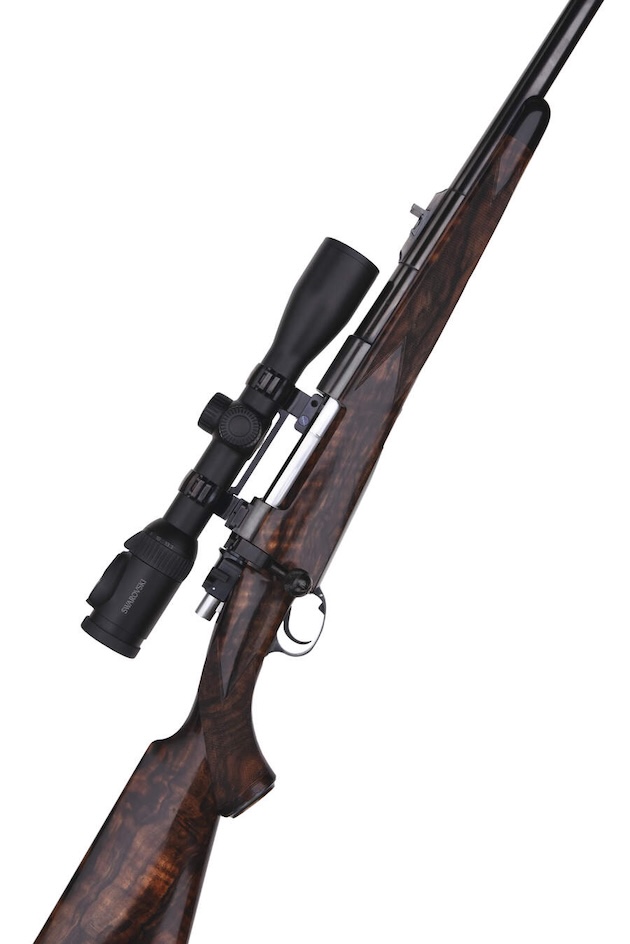
This sophisticated gun is available in three grades
Technical
Mauser’s 98-style action – a variant of which is at the heart of the new H&H takedown rifle – is famed for its reliability, strength and ‘controlled feed’. The mechanism is cocked when the bolt is raised: the cocking indicator emerges from the rear end and a three-position flag safety can be engaged. The cartridge is gripped by a non-rotating extractor all the way into the chamber, during firing and until it is ejected. British gunmakers immediately recognised the sporting potential of the 98. They also commissioned longer variants for use with new high-velocity cartridges such as the Rigby .416 and H&H .375 belted magnum, and specified single or double square bridges to accommodate improved sighting systems. The rifle as tested has an internal slanted profile and staggered-column floor-plate magazine (a reintroduction, as not all 98s have the same profile). A convenient but secure release catch in the trigger bow allows the floor-plate to be freed for cleaning.
Shooting impressions
I shot the new rifle at Holland & Holland’s Northwood ground, a remarkable facility incorporating a 100-yard rifle range and a freeze-frame hunting cinema. I was joined by the company’s Michael Ray-Jones and Georgie Stanford, the latest member of the instructing team. The new rifle did not disappoint. Comfortable stock shapes, evolved from classic forms, were sound. The comb, grip and leathercovered pad were exceptionally good. The gun cycled and chambered the .375 H&H belted-magnum round with butter smoothness. Its single-stage trigger broke at just under 4lb. Felt recoil (more push than shove) was below average for a big rifle. Accuracy was excellent too. RWS 301-gr loads made a first threeshot group of .9in about 1½in high: perfect. This provides an all-round biggame zero, which enables shots without aim-off to 200 yards.
Overall verdict? Not inexpensive but truly impressive.
For expert gun reviews every month subscribe to The Field magazine and save on the cover price.