




The plug-in hybrid version of this popular pickup deals effortlessly with tricky terrain, whether environmental or economic.
Ford Ranger Phev Wildtrak reviewed by The Field magazine


The Ford Ranger is our nation’s favourite pickup. Launched a quarter of a century ago, it now claims more than half of the UK’s pickup market, putting it in the top 20 of all cars sold annually. It has endured as a rugged and reliable workhorse, beloved of tradesmen, but it was the taxman who unwittingly helped to transform the brand when company cars were clobbered as a benefit-in-kind. Pickups escaped by being classified as commercial vehicles, with the result that higher-specification and more luxurious versions were introduced.
Even so, we’ve never quite taken to pickups in the same way as the Americans. In the US they account for one in every five vehicles on the road, compared with one in 100 here. Across the Atlantic, pickups are regarded as family cars and of course everything is bigger, including the vehicles themselves, the parking spaces and in some cases the ample backsides that require cavernous and well-upholstered seats.
Still, HMRC can’t bear what they consider might be a loophole, and the idea that a few tradies might actually be using their pickup as a family car grated. So last April the tax paid by drivers on double-cab pickups purchased through a company was quadrupled. Once again, farmers were hit, together with the builders, plumbers and contractors who rely on these vehicles.
Predictably, sales fell sharply. But all is not lost. Businesses can still claim VAT relief on most pickups. And just when it was needed, last spring Ford launched a plug-in hybrid version of the Ranger. By pairing a 2.3-litre, four-cylinder petrol engine with an electric motor, the Ranger PHEV not only enjoys cost and tax advantages but it also delivers more torque than the pricier V6-powered Raptor version.
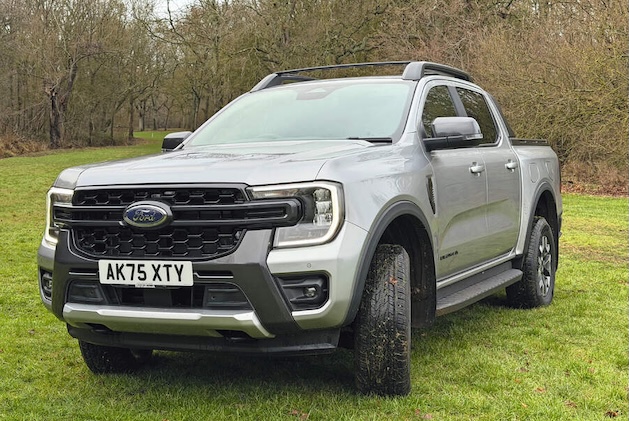
The Ford Ranger plug-in hybrid
With comfortable seats, a quiet cabin and a commanding ride height, the Ranger is an enjoyable on-road drive. The PHEV performs briskly, first using its electric motor and also when the petrol engine seamlessly cuts in. You can choose whether to drive on all-electric (in which case the claimed range is 27 miles), petrol only, petrol while charging the battery (which will take about two hours) or petrol and battery combined.
The Ranger is equally capable off-road. You can switch between rear-wheel only or four-wheel drive, high or low range, and select for various conditions: ‘sport’, ‘eco’ or ‘normal’ depending on how green you’re feeling; ‘tow’ for your trailer; ‘slippery’ for wet roads; ‘mud/ruts’ for the farm or shoot; and ‘sand’ for the beach. I didn’t find any rivers to wade or hills to climb on the farm where I drove the Ranger but with its locking rear-wheel differential the pickup dealt effortlessly with muddy tracks and deep ruts.
Using electric-only mode the PHEV can off-road in serene silence but this is no mincing motor. It can tow three and a half tonnes and unlike the Raptor has a payload of a tonne, making it VAT recoverable. You can even specify 240V power sockets in the load bay, with enough amps to run power tools, a fridge or even a barbecue. The Wildtrak version I tested had a well-appointed cabin with plenty of gadgets, including leather seats, a digital screen and natty cup holders.
I’m not surprised that the PHEV was Parkers’ Pickup of the Year. An all-electric Ranger is anticipated next year, though for us rural types that might be a volt too far. Meanwhile the PHEV has five seats and tax advantages. It’s a great moment to ditch the boring family car, beat the Chancellor and emulate our American cousins. Because as their saying goes, ‘city boys got pickup lines but country boys got pickup trucks’.

Our correspondent puts the pickup through its paces
Ford Ranger Phev Wildtrak
- Engine: 2.3-litre petrol four-cylinder/11.8kWh battery plug-in hybrid
- Power: 207kW/281hp
- Transmission/drivetrain: 10-speed automatic, 2WD/4WD
- Top speed: 105mph
- Acceleration 0-60: 9.2 sec
- Fuel efficiency: 28.2mpg (mixed use)/94mpg (max battery use) combined
- CO2 emissions: 68g/km combined
- Price: £46,841 (excluding VAT)
This article was published in the March 2026 issue of The Field magazine. For more articles like this and to save on the cover price, subscribe here.