



Intelligent, brave and playful, the handsome Irish terrier makes a boon companion in both the field and the family home writes Steven McGonigal
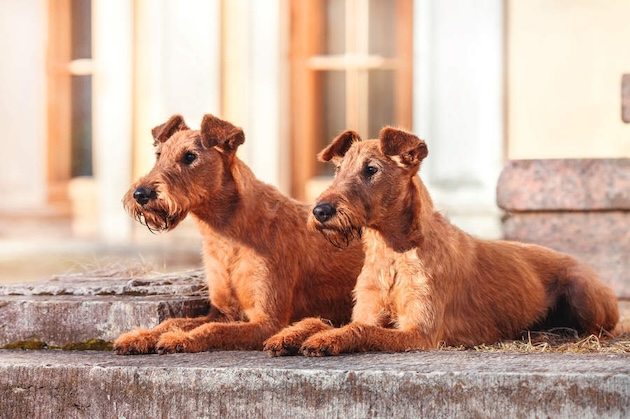
The Irish terrier has been described many ways historically: the farmer’s friend, the poor man’s sentinel and the gentleman’s favourite. In Ireland he’s often known as the ‘red devil’, so it is fair to assert that the Irish terrier means different things to different people. What everyone can agree on is that the Irish terrier is a unique dog: a breed as much at home in a city apartment as killing rats and other pest species on a rugged Irish farm, admired for its courage, tenacity and gameness but also its affinity and special bond with children.
Guard dog and pest controller
These adaptable dogs were in existence for some years before being known as ‘Irish terriers’ and were the first terriers recognised by the Kennel Club as a pedigree breed in 1879. They began simply as a rough-coated farm dog, living and working alongside the family as a guard dog and keeping down pests, which in the 18th century and before abounded every farm. Today’s Irish terrier stands around 18in to 20in tall and weighs between 251b and 27lb with deep brown eyes and what is described as a ‘golden red’ or ‘wheaten’ coat. The Irish terrier is well balanced with straight front legs, tight neat feet and rear legs that drive him forward. He is a dog that is well put together; ‘a dog designed by a dog’ some might say, as he has no exaggerated features and is just the right size to ‘stand to the knee’.
Colours
Historically they came in a few different colours and were much smaller in size than they are today. They started to emerge as a breed in the 1870s, and at the Exhibition Palace Show in Dublin in 1874 the class was split into Irish terriers over 9lb and those less than a third of the standard weight in today’s types. With variations in colour and size but still with common characteristics such as a wire coat, body length and the famed ‘Irish’ temperament, it took another five years for the Irish Terrier Club to be formed, alongside Kennel Club recognition. Over the next decade the variation in colours (predominantly black and tan) was bred out and a breed standard was put together, which was approved by no fewer than 24 individuals who had made a contribution to the breed. Irish terrier clubs sprang up across the country as the breed grew in popularity as a companion and show dog.
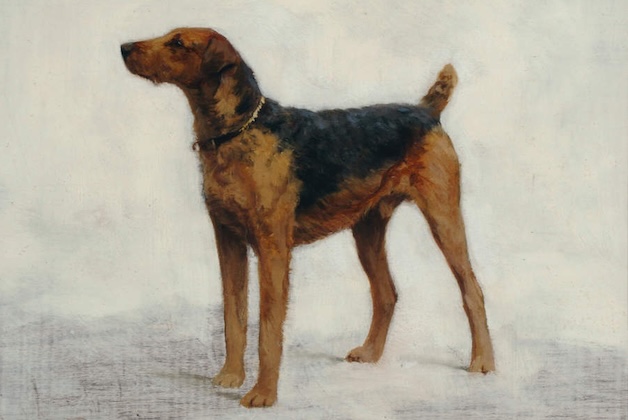
‘An Irish terrier’, a 19th century painting in Calke Abbey, Derbyshire
Irish terrier history
William ‘Billy’ Graham is a name that crops up in almost every Irish terrier discussion or article. He is often credited with producing the show-standard Irish terrier of today, with his ‘Killiney Boy’ frequently cited as the father of modern Irish terriers. Other dogs that have helped make Irish terrier history are the champions Erin, Sporter, Garryford, Breda Rattle, Breda Mixer and Breda Muddler. Graham is on record as remarking that “Noah had no need to take a pair of Irish terriers on his Ark as the dogs would swim alongside so well”.
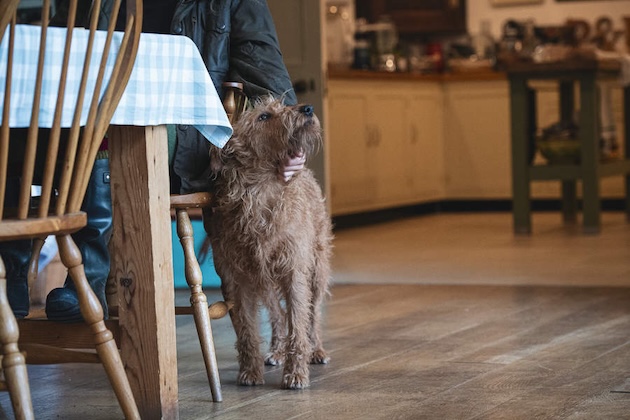
It is easy to see why Irish terriers are held so affectionately in their owners’ hearts
Intelligent, affectionate, playful
Lucy Jackson, a lifelong Irish terrier enthusiast, an author and patron of the Southern Irish Terrier Society, describes these dogs as “tough, determined, strong with fortitude and endurance, and can run like the wind”. She adds: “But they are also intelligent, affectionate, playful, intuitive and are almost spiritual.” Jackson has loved Irish terriers since a child when an Irish terrier puppy named Jock or ‘Jocky Boy’ arrived as a gift for her older brother. “I have few memories of childhood that do not include Jock: the games, the walks, picnics, holidays, busking for the war effort. We were embarrassing, uninvited guests ‘turning up’ at every village gathering, at school, church and sports days. I remember the endless laughter he brought us and the final tears,” she recalls.
“I have never been without one. Irish terriers have run through my life, each marking out an era that remains completely their own: when my children were babies and growing up, through to the noisy, energetic teenage years and finally their leaving home and followed by their continuous phone calls to ask about the dogs,” recalls Jackson.
“Irish terriers have been an enormous influence on all our lives, and helped to create a family mood of amusement and affection. Now as a widow, I live with my beloved Liberty Belle, who is no saint and provides me with constant entertainment, and is undoubtedly one of my life’s great pleasures. Apart from the joy they have given me, their welfare and promotion as a breed have been an enormous interest and a lifelong commitment. I served on the committee of the Irish Terrier Association for many years and have the honour to be their president. I am not just a fan but a devotee.”
First World War soldier dogs
The Irish terrier is known for toughness and grit, along with its oft-quoted conviviality. Such qualities saw the breed find its way to the trenches of the First World War. Lieutenant Colonel Hautenville Richardson, who set up the British War Dog Training School, held the Irish terrier in high regard. These ‘soldier dogs’ worked as guard dogs but also carried out other vital tasks. They lived and died alongside troops in the trenches. Richardson noted that ‘they could work harder and longer on a bowl of biscuits than any other living creature’.
He wrote in his book British War Dogs: ‘Many of our best dogs were Irish terriers and Welsh terriers.’ He continued: ‘These little fellows were remarkably easily taught, and were tremendously keen on their work.’ Rats bred in the trenches in great numbers, which made conditions even more miserable, and the Irish terrier excelled in catching them but Richardson stated that these dogs also possessed a characteristic that made them a little less useful as messenger dogs: ‘They are fond of greeting friends… old, new and imaginary.’
Breed heritage
In modern Britain and Ireland, the traditional role of the Irish terrier has somewhat diminished. For many, he is now a show dog, a companion or household pet. However, there are many enthusiasts keeping the breed’s heritage alive and working them as they have historically been used: catching rats, flushing rabbits from cover and assisting as a gundog of sorts. “Any attempt to train them as a gundog will fail,” warns Jackson, as she believes “they are not happy to be bossed about and told to sit, stay and retrieve like a labrador, but can be useful on a shoot”.
Lurcher type
The Irish terrier is also often used in the breeding of lurchers, especially in its native Ireland. The positive traits of the breed intertwine well with greyhound blood, creating a highly successful lurcher type that succeeded on the field and became popular from the late 1980s onwards but has gradually reduced over the past decade, with only a handful remaining. This is no reflection on the Irish terrier and was down merely to a change in tastes among lurcher enthusiasts.
Elsewhere we find the Irish terrier working in a variety of countries and roles. Some years ago while attending a driven hunt for wild boar in Germany I was surprised to see several Irish terriers form parts of the driving dogs. The owner, Michael Sprenger from the north of Germany, travelled to many driven hunts across the country in winter and had a mixed pack of dogs that drove boar and deer to guns. His pack also contained wire-haired dachshunds, Patterdale terriers and Swedish lapphunds. “Irish terriers are more compact than the traditional Heide terrier,” says Sprenger. “They are faster, very tough and have no problem covering many miles in heavy country. I found they were injured less often due to being more nimble and athletic, and never were a worry of going underground after a fox as they are simply too big.”
It seems this European style of hunting suits the Irish terrier extremely well and he has found himself a niche across Europe as a dog for pursuing larger game and driving it to guns, retrieving smaller quarry and working, in many instances, as a blood-tracking dog for following up and recovering shot deer. Often noted for their quick-thinking ability and daredevil attitude, it is easy to see why they fit these roles so well. Daniel Sutton is originally from the north-east of England but has lived in New Zealand for the past decade and owns three Irish terriers who work regularly, driving a variety of quarry to the gun, retrieving and catching smaller game, and tracking and recovering deer and feral pigs. “They are absolutely versatile; neither the heat nor the cold bothers them and they will go as long as I want to go, they work hard when we are out and play with the chickens at home,” he says. “I have found them the most loyal, enthusiastic and funny-charactered dogs, and I could never see myself without one, should I be in New Zealand or back home.”
Healthy
Although classified as a heritage breed, the Irish terrier isn’t considered ‘vulnerable’ and is not regarded as in danger. However, it isn’t in the numbers it once was. Despite this and a relatively narrow gene pool, it is a healthy breed and suffers no major health problems so often found in other pedigree dogs. Hyperkeratosis, more commonly known as cracked pad, is one concern. This can appear on a dog at around four to six months of age and is a hardening and thickening of the foot pads that can cause pain and lead to infection. Thankfully, since 2014 it has been possible to genetically test for the condition.
With its good health and love of life and work, it is easy to see just why Irish terriers are held so affectionately in their owners’ hearts. What’s not to like about a kind spirited, loyal dog, with a playful nature and a love for children, coupled with intelligence and a fearless attitude?