By Robert Cuthbert of The Field
Thursday, 25 March 2010
Pigeon shooting...Robert Cuthbert talks to a team who shoot pigeon in their tens of thousands

Rather than completely obscuring yourself, you need to break up outlines, while, vitally, being able to see out. There's no point building a fortress only to have to pop your head over the top every five minutes, scaring off anything on its way to you." Sound advice from Peter Schwerdt, renowned game-shot and woodpigeon nemesis.
I spent a day with him pigeon shooting in a hide close to Andover. As I studiously noted the technical aspects to his approach, multi-layered hide with old-fashioned Army scrim netting and Advantage mesh forming its bulk, a pattern of 15 real pigeon decoys breasted out, I was quite surprised to see a pigeon magnet rigged up. As Richard Lovell, Peter's friend and guide attended to a gently nodding flapper, provocatively I ventured that pigeon magnets were the work of the Devil, surely, and frowned upon by most traditionalists.
"Look," he said, not quite rising to a fairly cheap shot, "there are a few purists who see pigeon as a game, not in a gamebird sense, but in a proffered chance sort of way. They feel that using a whirly is not quite the done thing. Of course, they're sport, tremendous sport, the finest perhaps, but we are here to control vermin." It was far from a hollow boast. In late November last year, Peter and a friend shot 1,082 in five hours in two hides three miles apart.
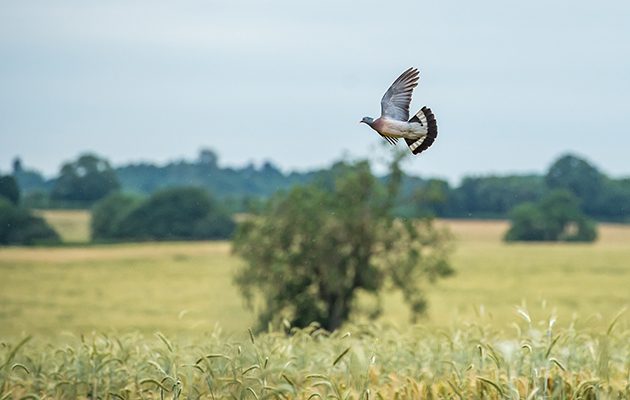
Lovell, who provided these photographs, is a Wiltshire-based pigeon guide. He doesn't advertise; he doesn't need to. Before he left us, to set up his own hide, I asked him precisely what made him and Peter such a devastating combination. "Honestly? I suppose it's because we've been doing it for 18 years or so. I spend over 300 days a year looking at pigeon and their movements. I'm good at getting him under them; he's great at shooting them. It's that simple."
I studied his decoy pattern and asked whether they were always positioned in an L shape. "Lord, no. Jumble it all up a little. L shapes work well, but then U shapes do, too; facing into the wind, of course. I tend to put the whirly at the rear of the pattern, inside the U if you like."
Once the magnet suddenly acquiesced and began to behave after initially refusing to play ball, Peter furtively squinted skywards before scuttling away into the hide, and loaded his gun. He tousled the ear of his black labrador, Medlar, set his clicker, hanging from a central hide pole, to 0000, and as I asked: "What are you using by way of hardware, Peter?" he suddenly stood up and blew away one of the hulking preconceptions I'd harboured about him.
He'd spotted a pigeon, wide to our left, which would not have dropped into our pattern in a month of overcast Sundays. With a shuffle to rectify his foot position, as his cheek met the stock, he barked: "Purdey - Live Pigeon gun," while he nailed an oblivious and rather luckless bird over his left shoulder. A live pigeon gun; the irony was deafening.
As Peter returned to his drum-like seat, my expression must have yelled volumes. His face creased into a beaming smile, so often seen in charity clay-shoot galleries. "Robert, you've got to take 'em on. Have a go at them." As Medlar did all sorts of manoeuvres to expel the bunch of feathers from the corners of his mouth, Peter sat down, reloaded and turned to me again. "It really isn't all about ratios and shots to kill. Yes, I keep a rough tally, but if a bird of that stature was presented to you on a driven pheasant day, Mr Cuthbert, who wouldn't have a crack at it, and relish it too, eh ? That was 40 quids' worth of anyone's money, was it not?"
I couldn't argue. It was all of 65yd, maybe more.
After folding a more straightforward bird over the decoys, Medlar was made to wait and fidget, eyebrows dancing, eyes darting everywhere. "I'm never in a huge hurry to pick dead ones; it's good to let the field quickly settle if you can," his master explained. Squinting out over the decoys, he continued. "I do love 'em like that first one, with a bit of acceleration. The faster pigeon, under a bit of power, they're wonderful. The floating, hovering things, ugh, they do nothing for me, those ones." Aren't those hovering, floating birds the staple of the pigeon-shot's day, over the pattern of decoys, I asked. "Well, yes," he said, slightly pained. "But, you see, for me, it's a little bit more than constantly shooting them in the V - the killing zone above the decoys."
I peered at the spent cartridge case, an RC4 28g load of 6. "They load these especially for me; they're easily the most devastating shell I've ever used. The whirly is an old Beasley model. It must be nearly 15 years old. Having been exposed to a whirly, I reckon woodpigeon have a memory of around two weeks or so, so it's no bad idea to mix things up; use them, don't use them and so on. The whirlies also only work in the right conditions, with a good wind, about 15mph ideally."
I asked Peter about the things people forget or those that just plain don't occur to them. He rose slowly, picking a pigeon from a handful of stock doves.
"Sturdy hide poles are a must, with good kick-plates for you to tread them into hard ground. Water is something people always forget - for your dog and for you. To keep it cold in the summer, freeze a partially filled bottle and it will slowly defrost during the day. That's an old Archie Coats trick, I think. When it's really cold and the wind is whipping into your back, I use a piece of hessian to keep the draught off. You must be comfortable. You won't shoot well otherwise."
Although pleased with these snippets of information, the one thing I really needed from the horse's mouth was the single tip to improve your chances greatly during a day shooting pigeon. "It's dull and it's time consuming but, as Richard said earlier, it's decent recce I'm afraid. You see, I run a little network as reconnaissance really is that vital for us. I have a family, I work in London, very often long days. I just can't put in the time necessary to make it all work. I've odd chunks of land here and there: Hampshire and a fairly big block just inside the M25, so it does take a bit of doing. Of course, the farmers don't hang around in telling us, either, and it all helps. Richard does a lot for me as does a chap who drives for me during the season. It's pivotal that somebody puts the time in, or you simply wait and nobody comes. I see my pigeon shooting season as the 1st of February through to the end of September, it all gets a bit hectic then really."
Yes, I imagine all those grouse just have to be shot by you, Peter. Taking the dig well, Peter fanned his diary pages at me and all I could smell was spent ammo.
"The 2009/10 pigeon shooting season has seen us shoot just shy of 13,000 birds in what - 50 outings or so, including days with friends. This includes some corvids. OK, the game dealer won't be interested, but we're here to keep the pests down. If they present themselves, they've got to go. And, you know,
I think we make a difference. There's no way we'd shoot 10% of the pigeon Richard and I see, but every thousand we shoot, I'm pretty sure, equates to around £300 the farmer saves."
As the shot rate stepped up and we neared three figures,
I nibbled my lunch and made my notes. I was looking for something to illustrate his commitment when his mobile phone trilled once before being checked and silenced. You couldn't have found a more basic Nokia. I quizzed him on the whereabouts of a Blackberry or similar. "Not here," he said. "Emergencies only." He stood sharply, and with a squirt of feathers another pigeon crumpled into the decoys and lay still. "This is what I'm here to do."
When and where to go pigeon shooting
■ January Rape and any frosted root crops such as potatoes, carrots, sugar beet and turnips if you have them.
■ February Rape, again, is a strong draw as the pigeon's core diet. Maize and other cover crops if chopped or ploughed in. And in hard weather, frosted crops such as cabbages, cauliflower and sprouts work well. Early spring clover can
be a big draw.
■ March Rape will more or less sustain pigeon this month.
As the soil warms, watch all spring drillings. Clover should be dragging them in by now.
■ April Late spring drillings and peas can prove fruitful. Tree buds, especially ash, can be great this month.
■ May A tricky month with a lot around to tempt them. Peas and spring-sown rape, which will just be showing. Barring surprises, a sticky month to get under the tap.
■ June Again, this month can be difficult unless they're belting the peas or seeds. That said, last June produced
some amazing bags over fields of failed rape, an opportunity not to be missed.
■ July Once again, peas, either growing or harvested, but also laid cereal crops, especially barley or wheat at that milky stage.
■ August Harvest time. Breeding pigeon will be on rape and almost any harvested crop. If hot and dry, remote drinking areas can be good places to find pigeon not busily engaged in attacking the crops.
■ September Similar to August, so don't overlook any freshly ploughed and harrowed land.
■ October A difficult month owing to the weather. Be vigilant with autumn drill but also with wild foods such as acorns and beech masts.
■ November A lot depends on how much wild food is on offer, how well any autumn drilling crops have grown and the timing of harvests such as beet. If wild food is bountiful they seldom leave it.
■ December Rape, mainly towards the month end, as other offers will exist. The odd stubble field may still drag a few in.
Rifles: how to choose the best
The Field guide to shotgun choke
Most shoots have ladies picking-up. HM The Queen is considered one of ... Read more
The William Powell Pegasus 12-bore is attractive, well made and good v... Read more
More than one gundog is a pack, it is essential that you keep the uppe... Read more
Paradise found on hill and stream: the best sporting holidays... Read more
The British Shooting Sports Council calls for support from Field reade... Read more
Subscribe today, have every issue delivered to your door and save money on the cover price.
Comments